



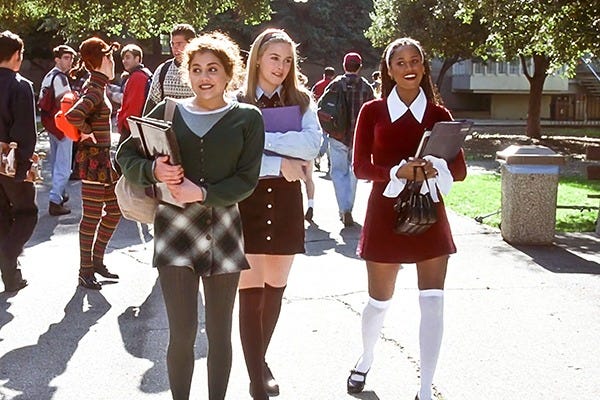
It was the summer of 1995. I’d be entering high school in the fall, so when my mom took me to see Clueless in the theaters, I was stoked. Immediately, I was sucked in. Sure, I wasn’t a wealthy Beverly Hills teen living in a gorgeous mansion with a computer-programmed closet (sidenote: could we get on this, technologically speaking? It’s 2026!), but I felt recognition. Alicia Silverstone, playing Cher Horowitz, opens the movie with a voiceover monologue about her family and her friends as we see a montage of her seemingly charmed life. And within a few scenes, viewers know that Cher, Dionne, and their circle of friends exist within a specific kind of society: that of high school. No matter your personal experience, a high school setting is a familiar one. It is presented in fiction as a somewhat closed society with its own rules and customs, which most viewers are familiar with.
Like in many teen coming-of-age movies, when newcomer Tai arrives on the scene, she finds fitting into a well-established social fabric is challenging. Since Cher and her friends are popular and well-liked, she accepts their insistence on a full makeover, leaving her personal style, interests, and even her taste in boys behind in an effort to fit in. And during the course of the film, viewers get to watch every character begin to resist the identities they have long adhered to in order to evolve.
High school in pop culture is a society where identity is assigned early and reinforced relentlessly. Fandom for these stories exist in part because viewers recognize those labels, resist them, or rewrite them through identification with characters as the characters themselves blur the boundaries that exist in this particular type of society. It is in the breaking of unspoken rules, and push and pull within this society structure that leads to character development. What can we learn about identity and society in the real world from these stories set in high school?
Locations: Opportunities for Story
Whether the main characters spend most of their time at school, or the entire piece of content is set at the school itself, there are only so many places where characters’ stories can play out. This is true no matter what kind of high school is depicted: whether it’s a public or private school, located within a city or suburb, or exists in an affluent zip code or average community. But these designated areas within a high school have their own rules. Like any society, there are places for work and study (classrooms, libraries), leisure and public spaces (cafeterias, lounges, plazas and the bleachers), and somewhat private or restricted areas (locker rooms, offices). These areas dictate certain behaviors; students are usually more or less democratized in class, even if they stick to certain identities (class clown, teacher’s pet), but speak and behave in entirely different ways with fellow students in areas where they have more freedom.
The setting is one that resembles any society: there are authority figures that do set rules and are more or less present, and personas the characters inhabit depending on the room. But in general teens are left to their own devices when dealing with conflict, identity, choices (where to sit, who to befriend, how best to study, personal organization) and maintain a level of autonomy to fulfill responsibilities while navigating relationships with friends and classmates.
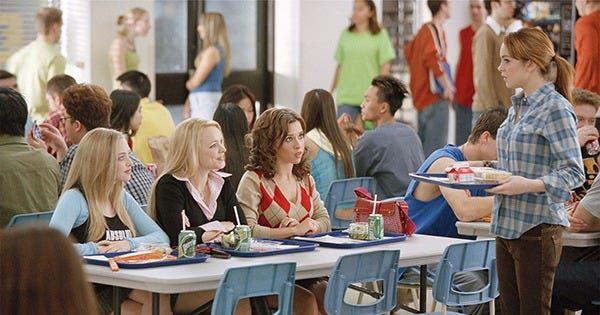
Since there’s a level of choice involved in, say, where to sit at lunch or what students can wear, these are situations where character can develop in a story. Choosing a different lunch table one day might require breaking an unspoken rule or setting up potential conflict whether it’s sticking to one table or attempting to mingle with a different social group. In Mean Girls, when Cady Heron is asked for the first time to sit with the Plastics at lunch and invited back to their table for the rest of the week, she is explicitly told, “on Wednesdays, we wear pink.” Her choice is to not wear pink, of course, and theoretically she can sit at whichever table she wants. But the invite plus the directive on what to wear sets up the central conflict of the movie: will she conform to fit in, and at what cost? Her decision to follow this social code and effectively become one of the Plastics marks a turning point for the character, and sets her on a path that will affect her sense of belonging and identity, both in and out of school.
Social Hierarchy
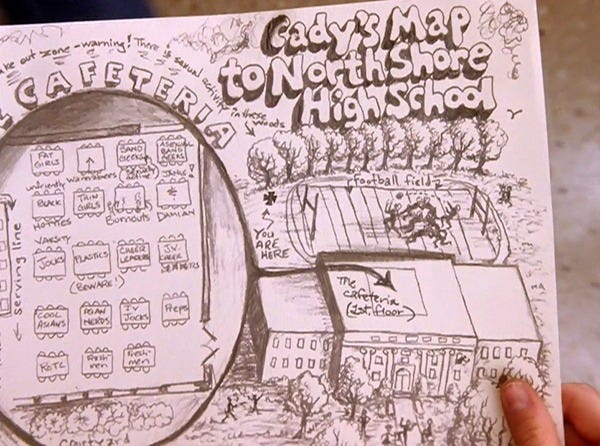
Staying on Mean Girls, let’s recap an iconic scene: Janice and Damian give Cady the rundown in the cafeteria about all the well-established cliques and where they sit: the jocks, band geeks, the popular girls (or, the Plastics), etc. Cady scans the room like she’s window shopping, searching for the table where she might fit in. A sense of belonging is important in any society, and one’s identity is the path to that sense of psychological safety. So, if you look around the cafeteria and don’t see others who either look like you or appear to have the same interests, you might be spending lunch eating your sandwich alone in a bathroom stall. Or, you might be asked to join a table and prove your allegiance in some way to its inhabitants.
But as I mentioned above, a character might wander over those unspoken lines of social demarcation on their journey to redefine their identities. They might mingle with classmates or love interests in other social cliques, or take up activities that might not align with their assigned identity. Mean Girls’ Cady is asked to join Mathletes early in the film but told not to by several new friends as it would be “social suicide.” While she spends the movie faking being unskilled at math to manipulate her social standing, in the end she wins her school the state championship.
In She’s All That, the movie’s central (admittedly problematic) storyline is that the most popular jock has to get the most unpopular girl to go to the prom with him as per a bet made with a friend. Class royalty Zack approaches the “uncool” artist Laney in an effort to get her to fall for him–or at least be his friend under false pretenses. Of course, along the way they find real connection–and not without some serious conflict. But it’s the intermingling of social tiers where the story takes place: his friends are cruel; hers are untrusting. Somehow they end up in a new place where those hierarchies fall away.
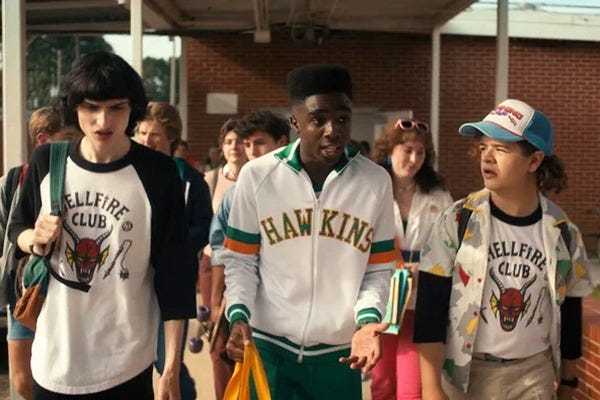
In Stranger Things 4, we see Lucas become a member of the school basketball team, effectively crossing social groups from nerd to jock. He hasn’t abandoned his friends per se, but they are sitting at a lunch table with Eddie Munson’s Hellfire Club (their Dungeons & Dragons party) while he gets to hang with his fellow teammates who have a different status at school. After the tragic events of Season 4, Stranger Things 5 opens with Dustin getting roughed up by the jocks for wearing Eddie’s Hellfire Club shirt, and Lucas–having been in their social group in the past–is able to demand that they stand down. A few years earlier, Lucas might not have had the power to end a standoff between the two groups, but since he’s been on both sides, his presence has power it didn’t before.
Rites of Passage
In all societies, rites of passage are markers of tradition, growth, and necessary change. In high school, sample rites of passage are starting a new grade or moving from lower classmen to upper classmen, first dates, getting a driver’s license, school dances, awards, prom and graduation. These are events where characters can further solidify or leave their former identities behind. In an episode of Never Have I Ever, the popular Paxton is voted to be the class speaker at graduation instead of the valedictorian. In his speech, he not only talks about shedding labels and expectations from others; he thanks friend and former girlfriend Devi for helping him push himself academically, instead of “doing a sexy dance” as some of the popular girls who voted for him wanted. He publicly recognizes someone his social class would never even predict he would befriend, much less date, for believing in his ability to be more than just a hot popular guy.
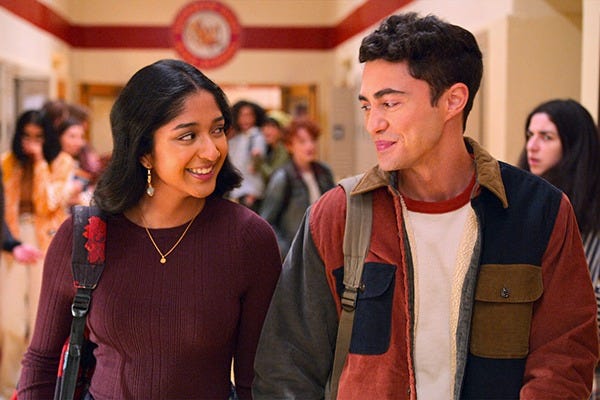
Afterwards, he turns the mic over the class valedictorian, whom he says has an earned right to speak. The impact is clear: Paxton uses a rite of passage moment to change a particular value prioritized during this event in this society–and he leaves instructions for the next class to break unspoken rules of identity in the future.
In 10 Things I Hate About You and She’s All That, the prom is the rite of passage on which all the action hinges. In both films, characters are challenged with persuading a specific person to attend this event as their date–and it’s where all the conflict in the movies take place. Both Kat in 10 Things and Laney in She’s All That realize they’ve become pawns in the games of others, and opt out upon learning the truth, with their feelings profoundly hurt. But these are opportunities for their love interests to turn things around, apologize, and show that they’ve learned something from the entire experience. They reject expectations, even old friends that held them to those rigid labels, and transcend the roles they were assigned at the start of their stories. Their personal growth during their time in that environment happens precisely because of how the society of high school functions.
Romance and Friendship
Relationships in any society often affect personal growth and social status. In high school, who you date or befriend can change your entire identity. Especially if a character breaks unwritten rules regarding who they are allowed, or expected, to date or befriend.
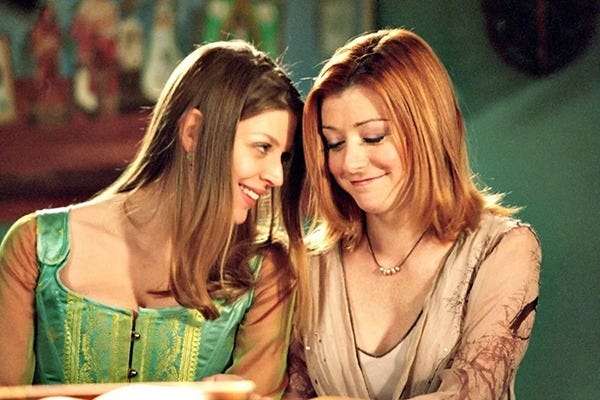
In Buffy the Vampire Slayer, Willow’s introduction on the series begins with having a crush on her best friend Xander. Eventually she has a romantic relationship with Oz, who just happens to be a werewolf in addition to a teenage boy. But Willow’s character evolves in later seasons when she meets a girl named Tara in a Wicca group. Through her friendship with Tara, Willow dives deeper into magic and her identity as a witch. And as the two form a romantic relationship, her identity is further redefined.
In One Tree Hill, the central conflict of two estranged brothers, Nathan and Lucas, is further complicated by a love story. Lucas, abandoned by his biological father and growing up with a struggling single mom, is buoyed by his best friend Haley. Both are outsiders at school. Lucas’ estranged brother Nathan is raised wealthy and privileged by their intense and demanding biological father. When Nathan needs a tutor at school, Haley is tapped to help. While Lucas navigates a hostile relationship with his half brother in school and on their school’s basketball team, Haley gets to know Nathan in a different way. Their friendship and romance is unexpected and yet, enduring. Its success defies pre-existing identity expectations, challenges the idea that Nathan is a spoiled star athlete and nothing more, and aids Lucas and Nathan in eventually becoming friends.

I, like most viewers, was charmed when Cher ended up dating her ex-stepbrother Josh at the end of Clueless. But it’s not just that my 14-year old self found a young Paul Rudd so incredibly charming (though he was, and still is). It’s Cher’s ability to transcend the idea of who she is to see Josh as a viable option when she’s spent the entire film caring that she and her friends only date “suitable” boys. The popular boy she hopes Tai will date leaves her alone at a gas station in the middle of the night, only to be mugged in her Alaia dress. Tai’s actual love interest might be a greasy stoner, but he’s sweet and doting. And the boy Cher has been trying to date during the whole film turns out not to be into dating girls at all. Cher has always relied on having the answers, but as it turns out she’s pretty clueless, and the labels she’s been using for the people around her are essentially meaningless. The structure of any society is just that: structure. How we move within it is what defines us, not necessarily what identities we are assigned. This is the magic moment that keeps me rewatching this film well into adulthood: the realization that the society we live in during high school is a training ground for life. We can be clueless about what we want, who we are, what others expect of us, and where we’re going next. But it’s where we also become enlightened, hone social skills, and take risks outside of our comfort zones.
I’d love to hear from you in the comments: What stories set in high school speak to you? And what are some insights you’ve gained about identity and society from these stories? Let’s continue the discussion!
Want more? Our Discord is where you’ll find everything you need to know about our ecosystem at Remarkist! Don’t forget to follow us on Instagram, tumblr, and Spotify for more insights on fandom—and hit that subscribe button so you never miss a thing at rmrk*st Mag!

This is so cool I came across this because I just wrote about Clueless myself and how it's one of my favourite comfort movies. Mean Girls and 10 Things I Hate About You are as well, I think the comedy is excellent in all of them. It's really interesting how centuries old source material can still be transformed into contemporary stories with social commentary of the time, for instance Clueless becoming a satire of 90s valley girls when it was originally a story about class hierarchy in Emma. That's the power of a timeless narrative structure.
This is cracking me up because I wrote a note for myself yesterday starting a list of "movies that always hit for me" and Clueless was number 1. Mean girls was also on it.