




One of my favorite books that has come out in recent years is Tomorrow and Tomorrow and Tomorrow by Gabrielle Zevin. Published in 2022, the novel connected with audiences and became a massive bestseller. It’s a sweeping coming-of-age story about two friends, Sadie and Sam, who meet as children in a hospital rec room. Later, they become long-term business partners who establish their own video game company as adults, and their friendship is tried over and over again as they navigate business, success, fame, and love. I myself was never really a big video game fan, so on the surface, I wasn’t sure if this book would suit my taste. But I was hooked from the first few pages and I’ve reread them many times.
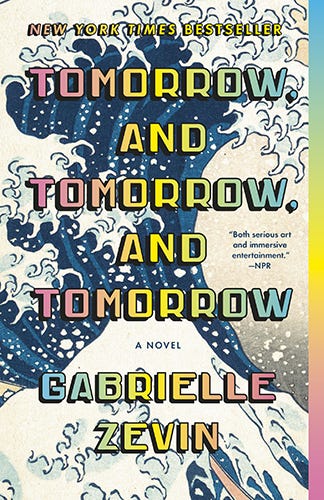
I promise no spoilers, because it really is a fantastic read. But the book begins with a chance encounter between old friends, when Sadie and Sam run into one another at a T station in Cambridge, MA. She gives him a new video game she’s been designing. It echoes their first encounter as kids which the reader learns about in the next few pages: at a children’s hospital, Sadie finds Sam playing a video game in a rec room. A little while after Sadie enters the room, he asks, “You want to play the rest of this life?” offering the controller to her, which she at first declines. But they play together over the next few weeks, developing a unique friendship.
Growing up in the 90s, I felt video games siloed my friends from social interactions. Their heads were in their GameBoys and Super Nintendos instead of going outside to ride bikes or chat with me. I thought gaming was the opposite of conversation, and took their desire to play through a screen as an escape rather than an interaction. So what struck me about the beginning pages of this book was the open invitation: asking Sadie to play is an open door into Sam’s life and world. Asking anyone to play, whether it’s a game or creating stories together like we do when we play with toys as children, is a gesture for connection and conversation.
An offer to play isn’t necessarily just entertainment or distraction: it is the beginning of a dialogue. Whether you’re on the playground, gamers in a multiplayer saga, or even fans engaging with stories via trivia, play involves call and response as well as mutual understanding. It is an ongoing exchange of signals, rules, and meaning between participants, between player and system, and between audience and story.
Play requires response: the foundation of conversation
“Tag! You’re it!” We learn it as kids early on that play requires a response. You know the feeling when you are abruptly “tagged” on the playground out of nowhere. You have two choices: you start chasing, or stand still, ignore the gesture, and subsequently become the class wet blanket. When someone says “hello” in a casual context, it’s customary to offer a “hello” back; otherwise you come off as rude or aloof. It’s the same with play. In conversation, one person speaks, the other responds. But in play, one person acts, the other reacts.
In any game, every move requires acknowledgment of the last. In a board game, you have to consider the last thing “said” and what your opponent might “say” next to choose your own move. In a game of pool, where the balls land on the table from your opponent’s turn requires you to be spontaneous and react to the situation at hand. It’s an elaborate improvisation where each player builds on what came before and what might come next. It’s not a monologue, but entirely relational.

Rules are the grammar of play
Language has rules and accepted aberrations to those rules; it’s how we communicate. Similarly, play has rules too–and that structure is how we establish conversational connection in a game. When we are all speaking the same language, or, playing by the same rulebook, play is communicative and productive. Some sort of shared understanding is necessary for play; it’s why people who speak different languages can interact effectively through games, like in professional or Olympic sports.
When we speak the same language, it doesn’t mean that we are destined always to understand one another. Surely misunderstandings happen all the time in conversation between those who know the rules of the same language’s grammar, or share dialectic customs. In gaming, this is extremely apparent. Think about a game of chess: you can do your best to predict the moves of the game in order to act and react accordingly. But while you and your opponent are speaking the same language, you might be having different conversations. In a game of strategic skill, it is imperative to understand not only the rules and language of the game, but the specific conversation your opponent is having throughout the session. If you’re not reading your opponent’s moves correctly, you might miss a move that they are hoping you’ll make in order for them to advance.
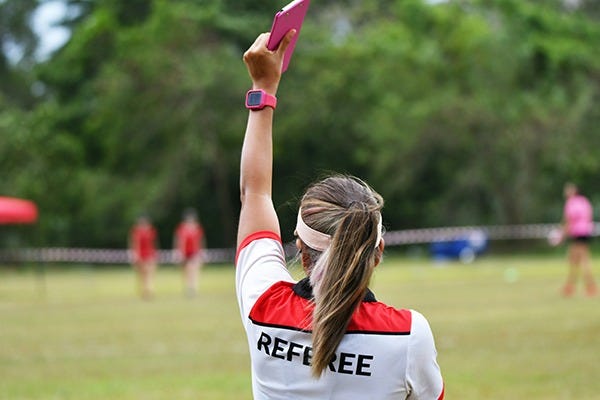
When we aren’t playing by the same rules, that’s when things feel unfair, go awry, and breakdowns in communication happen which can break trust amongst players. But players can always test the limits of rules and structure, which we see in professional sports all the time. Referees and instant replays exist to help us understand the nuances of every rule–just like language can be nuanced, and meaning can be examined from many angles.
A conversation between creator and audience
Play isn’t just a conversation between players; it is a conversation between players and the audience as well. A prime example is the Olympics, where we follow not only the Games themselves but interact with the Games as fans, becoming invested in the players and their stories as well as their skills. When it comes to sports, specific players and games become mythical anecdotes in culture: times where an entire city got to claim to be champions when their team won a title, or a single player being traded to another team could result in a decades long curse (sorry, Babe Ruth).
I was moved when the Seattle Seahawks won the Super Bowl earlier this year, and they addressed their fans as the “12s.” I don’t follow Seahawks football (or…any football), but I quickly learned that in 1984, the Seahawks retired the number 12 jersey, because their fans always serve as the “12th man” on their team. The support of their monolithic fanbase, the 12th man, is integral to their gameplay. The audience is as much part of their team as they are. It’s a shared language, even if you wear the jersey off the field, in the stands.
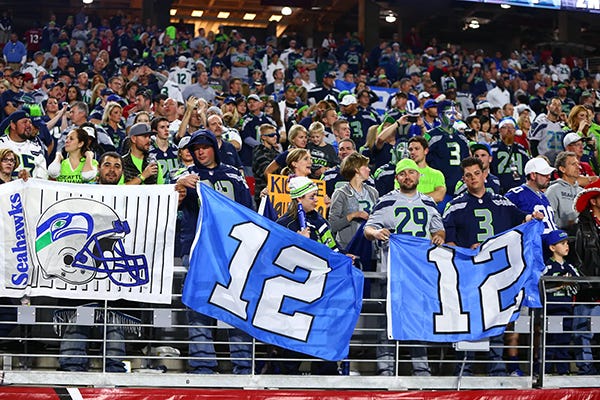
An audience also converses with the game in their own creative ways. They might cosplay to attend a viewing party or write fan fiction about the players. Their responses to the game are as emotional as if they themselves were playing, and they react in creative and social ways.
Fans create relationships independent of the game, but around it. Fantasy leagues have become a huge business because fans want to be part of the gameplay in a unique and creative way: building their own “teams” out of the players already on fields across the country, and actively tracking their progress. Fantasy leagues become their own social ecosystem, and are worthy of their own attention. The comedy series The League illustrates just how much the game can infiltrate a social group of friends and their loved ones–for better or worse.
In one of my favorite movies, Fever Pitch, Jimmy Fallon’s character Ben meets Drew Barrymore’s Lindsey, and the two have excellent chemistry off the bat (pun intended). But he’s self conscious about one thing: when she finally learns of his level of fandom for the Boston Red Sox. As an outsider, Lindsey has fun joining the fan conversation: dressing in team t-shirts and hats, eating hot dogs at Fenway, trash talking the other team and cheering with fellow fans. But before long, she realizes Ben has somewhat of an obsession. Things get complicated when Ben feels he might have to choose between Lindsey and his season tickets. What the movie illustrates is how serious the bonds are between a team and their fans, and between the fans themselves. Ben’s ballpark seats were passed down through family, and his identity is wrapped up in not only his love of the team but sitting in those exact seats for every game, surrounded by lifelong friends.
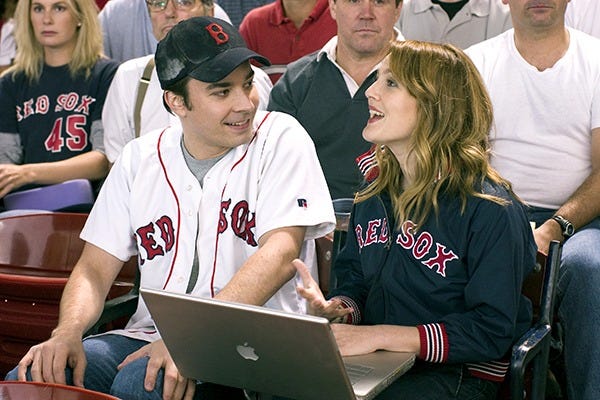
For spectators, trust, deep friendship, inside jokes, and camaraderie are all tied to the game they aren’t even playing themselves. But it is why we hear sports fans say “we won” versus “the team we support won.” The relationships that form are as real as if everyone was on the field.
A deeper meaning
Again, no spoilers. But when I’d finished Tomorrow and Tomorrow and Tomorrow, I went back to the very first page and reread the first two chapters. It occurred to me that the whole plot of the novel was an invitation to play, and I had said yes. I followed the events of the book as closely as any game: I identified the players, the spectators, the stakeholders, the NPCs. I noted when Sam and Sadie said yes to a game, and when they said no. Each invitation was combined with a life moment for each of them, an opportunity for connection with another human being, whether a personal relationship or group.
The play Take Me Out by Richard Greenberg is a story about a star baseball player who comes out as homosexual, igniting a firestorm of turmoil involving racism, sexism, homophobia, and masculinity, especially in sports. I had read something (the title of I simply cannot remember now) in my university studies about the game of baseball, how it is a sport that mimics the American spirit: we go out, try to connect with a target, make a run, maybe get on a base/achieve a milestone, and at the end of the day, come home. The game is a metaphor for life. There is a monologue in the play that sums up the idea beautifully; this is a short excerpt:
…I have come to understand that baseball is a perfect metaphor for hope in a Democratic society.
It has to do with the rules of play.
It has to do with the mode of enforcement of these rules.
It has to do with certain nuances and grace notes of the game.
First, it has to do with the remarkable symmetry of everything.
All those threes and multiples of three calling attention to…the game’s noble equality.
Equality, that is, of opportunity.
Everyone is given exactly the same chance.
And the opportunity to exercise that chance at its own pace…
What I mean is, in baseball there is no clock.
What could be more generous than to give everyone all of these opportunities and the time to seize them in, as well? And with each turn at the plate, there’s the possibility of turning the situation to your favor. Down to the very last try.
And then, to ensure that everything remains fair, justices are ranged around the park to witness and assess the play.
And if the justice errs, an appeal can be made...
Because even in the most well-meant of systems, error is inevitable. Even within the fairest of paradigms, unfairness will creep in…
…Another thing I like is the home-run trot…
What I like about it is it’s so unnecessary….the ball’s gone….
For all intents and purposes, the game, at that moment, is not being played….
Instead, play is suspended for a celebration.
The reward for a solid conversational connection is understanding. In the moment where a batter hits a home run out of the park, the pitcher and the batter have had their exchange, and the understanding of the moment is clear. Players and spectators pause and reflect on the new plateau of the game. But even the best attempts at conversation fail sometimes, and that’s just the game of life. But we keep playing, we keep watching players, and we keep attempting to connect with others around a common game in hopes of finding understanding and community.
Want more? Our Discord is where you’ll find everything you need to know about our ecosystem at Remarkist! Don’t forget to follow us on Instagram, tumblr, and Spotify for more insights on fandom—and hit that subscribe button so you never miss a thing at rmrk*st Mag!

-you’ve convinced me to continue reading this book. I was enjoying for a while and then it stopped holding my interest … gonna pick it back up - especially since I loved her other book - the storied life of AJ Fikry. Thank you for giving me new perspective