



If you’re like me, you have a bunch of streaming platforms with a watchlist a mile long on each. But every time you sit down to enjoy a movie or series, you fire up something you’ve seen not only once, but several times before. And returning to an old fave doesn’t even begin to put a dent in your watchlist.
Here’s the thing about putting on a show for the 15th (or 50th) time: it’s not just a comfort watch, although that may be your initial reason for clicking over to a show you’ve seen before. I spent the better part of my twenties and thirties putting my Gilmore Girls DVDs on in the background while I did everything else: work, reading, putting away laundry, cleaning…even sleeping. At a certain point, I could recite every episode without looking at the screen. The background noise was like music, and we don’t ever judge ourselves for listening to our favorite bands and songs over and over; that’s what music is for!
We live in a culture where there’s always new content, everywhere. Constantly. There are endless queues on our streamers, and believe it or not, cable and network TV still exists and there’s great stuff there too. And social media content, video podcasts, and general internet entertainment can account for hours of viewing time a day. Yet we return to the same stories. Why?
Sometimes I think I’m being lazy, or participating in the equivalent of not trying a new food or getting out of my comfort zone to do something different. But I have come to realize that obsessive rewatching is not a failure of adventurousness or a symptom of comfort-seeking avoidance. Instead, I have come to think of it as one of the most sophisticated forms of engagement with fiction. Am I attempting to forge a valid excuse for firing up Happy Endings, an excellent sitcom from the 2010s, for the 30th time instead of trying out something completely different, like House of the Dragon? Yes. But I also have come to realize that obsessive rewatching is a practice that develops critical thinking, deepens curiosity, and reveals truths about storytelling that a single viewing can never produce.
The limits of the first watch
When you hear a song for the first time, are you tuned to the lyrics or the melody? Is it indeed one or the other? I have always been a melody first, lyrics later gal (unless it’s Taylor Swift). Others might experience the opposite. The point is, it takes a few listens of a song to consume it completely. It’s the same for watching movies and TV shows. The first watch is limited in a variety of ways.
On a first watch, the brain is being hit with a lot. We might just focus on plot, or the overall vibe. The first time I watched The West Wing, I was overwhelmed with the vibe of the show, which I really loved: the fast pacing, the signature Aaron Sorkin walk and talks, the hilarious one-liners from CJ, Josh, Toby and Donna. But a lot of the time, I couldn’t follow the actual plot. It was too much information, and the scripts were dense. On a third rewatch, I finally understood some of the more complicated, nuanced, political dealings that happened on the show. And it was so rewarding to finally absorb it all on subsequent rewatches. But who can focus on the plot when this walk and talk is so great?
On the first watch, we might not have a lot of processing capacity beyond the basic plot-driven facts: the who, what, where, when, or why. And since the story is new, we might miss foreshadowing, or the nuances in the storytelling that sets up the ending. Maybe we miss pieces of the thematic architecture, understanding only at the end that the show was a play within a play, or told in memories, or…told in reverse. Maybe dialog has more meaning than you pick up on during the first time around.
A first watch is an orientation; it can be really exciting on its own. But if you love to dive deeper, it’s a preview to the main event: a second or third viewing. Rewatching once you know the ending can be really rewarding; the scene that looks like one thing in episode one and becomes something completely different when you return to it knowing episode ten. Or, watching a movie like The Sixth Sense knowing the ending becomes a completely different experience than watching it for the first time.
Some works are designed for return, built with layers that reward the attentive rewatcher specifically. A rewatch is where you notice Easter eggs you might not have before, or realize that the last episode featured a pretty good callback to the first. When I finished reading Tomorrow, and Tomorrow, and Tomorrow by Gabrielle Zevin, I immediately turned back to the first page and reread the first 2-3 chapters. I immediately saw snippets I’d forgotten, seemingly insignificant mentions I now knew, knowing the ending of the book, held a ton of weight.
Freeing our attention
On a first watch the brain is fully occupied tracking plot, leaving almost no capacity for anything else. It’s like going on a rollercoaster for the first time: you’re not sure of the ups, downs, twists and turns so you’re taking in what you can and getting surprised along the way. A rewatch eliminates that cognitive burden entirely and the eye is suddenly free to notice everything it missed the first time.
Our brains are also free to engage in anticipation. To further the rollercoaster metaphor, now we can look forward to the best drops, or, the most powerful moments of a series or movie. Whenever I’m watching a movie I love, I am gearing myself up for those rollercoaster-equivalent moments. In May 2026, theaters will show the iconic movie Legally Blonde in honor of its 25th anniversary. I know I’ll be waiting in anticipatory glee to hear “What, like it’s hard?” for the hundredth time–but this time on the big screen again and with other fans.

Humans are also hard-wired to recognize patterns. Neuroscience confirms that the brain is so good at recognizing patterns, that we actually crave it. We like to find structure in unfamiliar territory. So when we are familiar with the content, repeated exposure allows us to see more and more each time because cognitively, our brains have built better maps of what we are watching. This is why fans of shows they’ve watched repeatedly might finally catch something out of place or mistake: a boom mic, a background character doing something strange that they’ve never noticed before, or a continuity error like a misplaced plate or strand of hair scene to scene.
Freeing up attention also can change our emotional reactions. I’m the kind of person that watched Stranger Things with one eye on the screen and my hand over my face just because I was so tense not knowing when a jumpscare was coming. I could barely process the plot because I was nervous. But on the third rewatch, I knew exactly when (spoiler alert!) Barb would disappear. I could watch the scene with two eyes open and just be sad to see her go. Knowing what is coming does not eliminate emotion but transforms it. Dread replaces surprise, dramatic irony replaces shock, a richer and more complex emotional engagement replaces the simpler one of the first watch.
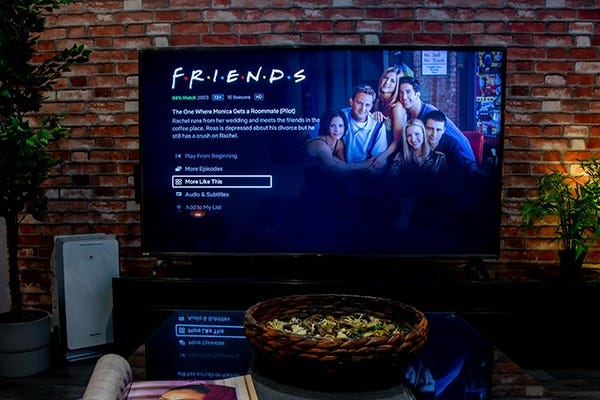
A known narrative as a safe container for genuine emotion; we can feel things fully inside that container. Fans often have comfort shows they return to like Gilmore Girls, Parks & Recreation, The Office or Friends because the characters make them feel safe…like actual friends.
What we’re really doing during a rewatch
I grew up an amateur dancer, and one thing we were trained to do was to get to a point with practice and repetition that the steps felt like second nature. Knowing a routine cold, so well you’d forget you were doing it, allows you to focus on the performance. It’s the same skill set when we know material well: we can focus on other things when we’re not preoccupied with getting from point A to B.
What I really love about a rewatch is the opportunity to develop a skill for what the literature community would call a “close reading.” Close reading is when you don’t just read the text (or watch the content), but you reread, over and over, to analyze it from different angles. Rewatching helps us develop a skill for close reading. As a former English major this is something I get really excited about: attention to structure, sensitivity to pattern and repetition, and awareness of the gap between surface and depth is all on the table in a close reading.
A fan of Gilmore Girls might say that Logan is Rory’s “Christopher,” meaning that when Rory gets into a relationship with a person from the world of the Gilmores (read: upper class, wealthy, lots of society rules), that relationship mimics that of her mother Lorelai’s relationship with her father. Engaging in this world is trepidatious; Lorelai ran from this world (and Christopher) when got pregnant with Rory. Their relationship didn’t survive because it was tied to the upper crust existence where social rules are adhered to. Rory is raised in a very different world, the one of small town Stars Hollow, where a Luke type (read: Jess) could be her romantic destiny.
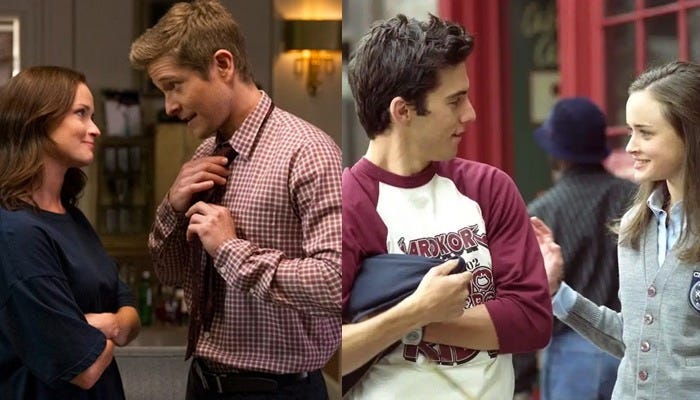
Picking apart these characters and what they represent, where they fit into the Gilmore women’s lives, and how their existence is related to patterns of identity and individualism in the show is all part of close reading a narrative. In other words, close reading allows us to build critical thinking skills.
Obsessive rewatching of a show we already love helps us watch new things too. When honed, this skill transfers to how we watch new content. A keen eye might notice a continuity pattern error quickly, or catch an Easter egg drop because they’re tuned to noticing details. Taylor Swift fans are so used to her hidden messaging in plain sight that she can’t even appear in a photo going out to dinner without fans taking detailed notice of everything she wears that might be representative of a new project. Sarah Chapelle of Taylor Swift Style breaks down every clothing, jewelry, and accessory item that might tell a bigger story about what the artist is up to. She is keenly aware of how Taylor tells a story, so she—and her followers—are primed to look for specific details. A person who rewatches obsessively begins to watch new things differently. They’re more attentive, more analytical, and more curious up front. They stop taking things for granted and instead are prepared to look for clues or foreshadowing.
Obsessive rewatching generates rather than satisfies curiosity. Returning to the text produces new questions rather than answering old ones. And furthermore, the rewatch acts as a gateway to adjacent curiosity: the show that sent you to the book it was based on, the film that sent you to the director’s entire filmography, the series that sent you to the historical period it was set in or led to more research. Or in the case of Gilmore Girls, the obscure cultural references that led you to learn more about them. For author Matt Browning, curiosity led to writing Gilmore Girls Pop Culture Reference Guide, a book deciphering the many references in the show.
Why we rewatch
These days there is just a lot going on. Our attention spans are at an all time low, constantly being hijacked by news, entertainment content, notifications, etc. The ability to be everywhere and see everything all at once from a small device you can fit in your hand is convenient, sure. But at the same time, it’s more than overwhelming. We binge a new show over a weekend and promptly forget about it two weeks later. We’re always looking for the next thing, and that’s not difficult, because the next thing is popping up on our feeds within seconds.
The choice to return to something known in a culture engineered for distraction is meaningful. In an oversaturated world, rewatching a favorite show or movie is a deliberate act of resistance against the attention economy’s demand for constant novelty. It’s also a conscious choice to slow down and revel in one fandom.
Rewatching also helps us build community. As we feel further disconnected, fandom around a franchise we have loved for many years on end gives us access to rewatch parties, in-person festivals, and conversations.

Rewatch podcasts, anniversary screenings, and even long-awaited sequels that have us rewatching the original content en masse (hello, The Devil Wears Prada!) make us feel more connected than ever. While a solo rewatch can be fantastic, participating in it with other fans exposes us to other opinions, perspectives, and collective intelligence of a group of attentive viewers. Rewatch podcasts, often hosted by superfans or creators of the content themselves, helps us take a look back and reframe content we loved in the past. We confront our opinions with a more evolved lens, which can be rewarding in and of itself.
So next time you feel bad about rewatching an old show when your queue is a mile long, don’t! Find other fans, search around for a rewatch podcast, or simply slow down and enjoy what you love.
Want more? Our Discord is where you’ll find everything you need to know about the Remarkist ecosystem including Folkic, our community app! Don’t forget to follow us on Instagram, tumblr, and Spotify for more insights on fandom—and hit that subscribe button so you never miss a thing at rmrk*st Mag!
