



I was in college in the year 2000 when the trailer dropped. I saw it online, a rare thing at the time, as YouTube didn’t exist yet. If I remember correctly, the trailer was only available to play on the movie’s website in addition to theatrical previews. And I’m sure a good chunk of that website’s traffic was courtesy of me and my ethernet connection inside my dorm room. The movie? Of course, it was the drama Center Stage, a story about a ballerina newly accepted to the most prestigious ballet company in New York and her and her classmates’ struggle with career, passion, skill, and…love.
Just last year, the movie, which became a cult classic and millennial favorite, turned 25 and the internet responded in kind, some even calling it the greatest movie ever made. The movie launched careers, like that of Zoe Saldaña’s, and featured famous actors like Peter Gallagher and Donna Murphy. The most exciting cast of the movie was the dancers, real ballet prodigies from various ballet companies.
When I look back on the film, which is equal parts cheesy and awesome, not to mention a pop cultural touchstone for women of my generation, I don’t think that much about how it became a cult classic over the past two decades. I think about the months before it opened in theaters, and my own relentless, kept-me-up-at-night excitement. I remember the opening notes of the trailer before anyone appears onscreen. I remember the sound of dancers whacking their pointe shoes on the floor to break them in. I remember the song from the trailer which ended up on the soundtrack. And I remember Mandy Moore’s music video for “I Wanna Be With You,” featuring dancer/actor Sascha Radetsky and scenes from the film since it was used in a pivotal moment. Sure, as a young dancer myself, I studied the choreography to the “Higher Ground” sequence when I secured a DVD copy later and performed it for nobody in my living room every other day for years. But I’ve been chasing that anticipatory feeling I felt before the film hit theaters for decades. And I have to admit: I haven’t had a ton of fandom experiences that come close.
Anticipation for something can be as exciting as the thing itself. Do you remember that television commercial for Walt Disney World, the one where the little kids can’t sleep because of her family’s upcoming trip? They’re “too excited to sleep” and it’s adorable. The ad works because we all know that feeling. Even the dad in the commercial can’t sleep.
Anticipation is a natural occurrence. As humans, we look forward to what we believe will be positive experiences. But anticipation can be wielded as well, and there is a certain art to creating, sustaining, and participating in it. Fans appreciate an engaged lead-up to a drop, because the waiting can be almost as fun–if not more–as the thing itself.
Manufacturing anticipation
Before the internet, we had physical advertisements, movie posters, book release dates, album covers, and theatrical trailers. A piece by Will Havens for Brown Film Magazine paints an informative and fascinating overview of the history of movie trailers. The first trailer appeared in 1913 for the Broadway show The Pleasure Seekers, and was filmed by a publicist for Marcus Lowe, the founder of MGM Studios. It was shown after the movie, thus named a “trailer.” The promo was a huge success, and soon became a staple of movie theaters. Founded in 1919, the National Screen Service (NSSS) dominated the trailer industry for the next forty years with their formulaic ads that featured splashy movie stars and boasted outrageous claims about the movies they publicized. These trailers promoted the technological feats of the films themselves, or the shock value. They were often narrated too, speaking directly to the audience about what to expect. Exceptions to the formula were given to filmmakers that were so influential that they could have creative control, like Orson Welles directly introducing Citizen Kane in voiceover to the audience.
When the NSSS was broken up as a monopoly in the 1950s, the industry and audiences were also changing. The rise of the filmmaker/auteur meant that trailers were more artistically grounded and evoked the feeling of the films as much as promoted them. With the onset of the blockbuster film in the 1970s, what started as a single promo in theater exploded into larger multi-level marketing campaigns that included multiple trailers at different lengths. Some trailers included entire plots with overt spoilers or iconic lines from the upcoming film, like Jaws including the line “We’re gonna need a bigger boat.”
Voiceover narration was always important to trailers, and the voices of trailblazers Don LaFontaine and Percy Rodriquez were heard in some one the biggest trailers ever. Rodriquez was renowned for horror films and movies like Jaws. LaFontaine voiced over 5000 trailers, and was well known for his “In a world…” line, inspiring the 2013 comedy In A World… written and directed by Lake Bell, who also starred in the film.
Today, moviegoers still love trailers and arrive at theaters on time to watch 20-30 minutes of them before the feature movie starts. But companies like Marvel have also perfected the post-credit trailer or extra scene, perhaps in a return to form of the original turn of the century era movie trailers. Building anticipation during the movie you’ve come to see is what gets folks talking and excited for what comes next. And the art of the post credit trailer is even making its way to live theater, which is unheard of. The Broadway musical adaptation of The Lost Boys includes a post-curtain call scene that fans speculate teases a sequel to the original movie the show is based on. This post curtain call scene was omitted after a few preview performances, and fan demand was so loud online in Reddit threads and on social media that it returned within a few days. This just confirms that fans love getting excited for what comes next, especially if the method of disseminating that information is unconventional and innovative.
Modern manufacturing of anticipation is multi-layered into massive marketing campaigns. In the 90s and 2000s, you could maybe catch a glimpse of a movie being filmed from a sidewalk photo published in a magazine. Today, because of social media, we now have access to behind the scenes photos up to the minute. The internet nearly broke earlier this year when Katie Holmes and Joshua Jackson, former stars of the teen drama Dawson’s Creek, were photographed filming Holmes’ movie, Happy Hours, which will premiere at the Tribeca Film Festival in June of 2026. Those early photos and buzz certainly worked on me; I am itching to snag a ticket.
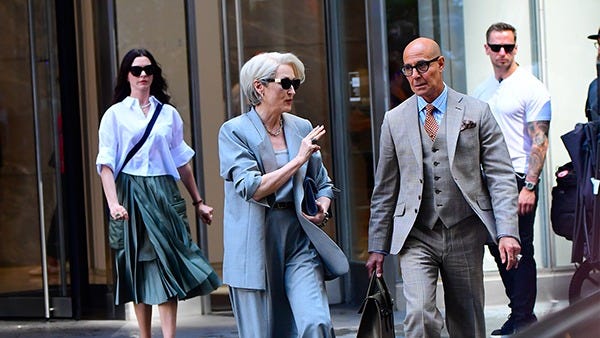
The same was true of The Devil Wears Prada 2, when on-set photos in the streets of New York City were released to the public in August of 2025. Trailers are fantastic, but there’s a certain excitement to seeing sneak peaks of the actors, costumes, and guessing what might be in store for the film based on the candid photos of the set. Fans now feel part of the content itself: we see part of how the magic happens instead of a curated trailer, edited to clips that make us feel what the filmmakers want us to. Instead, we can use our imaginations to guess what might be going on in the film rather than being told what the plot is. These types of “leaks” (or well-placed PR made to look accidental) create buzz, and it hits particularly hard for nostalgia content. In the case of both Happy Hours and The Devil Wears Prada 2, this especially works as fans dig into what they already love about the stories and players involved–which begets more excitement.
In the waiting, our imaginations take over, and fans act as co-creators of the content way before it arrives. It’s the one true time fans have control over the content itself, if only within our own frenzied conversations. It’s the period in which we can guess what the content will be about, debate with other fans about what we think might happen, and paint the best case scenario in our minds for what we will eventually see. Countdowns also help us create rituals around our fandoms: we mark time together, which builds community and collective identity.
The medium shapes anticipation
Recently I was listening to a podcast where the hosts were discussing how crazy it is to remember that in the 1990s, “TGIF” programming on ABC was a thing, as well as “Must See TV” on NBC. Imagine waiting a whole week to see four to five shows lined up for you, that were so good (or at the very least so popular with everyone you knew) that you simply would never miss them, over the course of three primetime hours every single week. The anticipation of looking forward to those weeknights could get you through a week of boring homework or your office job. And, the ensuing conversation at the proverbial water cooler the next day could sustain you, at least until the shows went on hiatus and you’d have to watch reruns.
A well-placed promotion for a show coming a season away could also get folks riled up. I was counting down the days to the 1998 premiere of Dawson’s Creek for actual months when they aired during episodes of Buffy the Vampire Slayer. The Lost commercials on ABC in 2004 were so captivating, it was a massive ratings hit from the outset, as 18 million tuned in to watch the pilot–and came back the next week. And the marketing team didn’t stop there. The hiatus between seasons 2 and 3 kept fans engaged by an innovative marketing campaign, the Lost Experience. A commercial that aired during an episode led fans to real websites for Oceanic Airlines and the Hanso Foundation, where they could find clues about the island in an alternate reality game. More games would be introduced between seasons 3 and 4. A new game called the Dharma Initiative Recruiting Project was implemented between seasons 4 and 5 and incorporated San Diego Comic-Con in 2008, and Lost University between 5 and 6.
And the piece that really drove Lost excitement? Waiting week to week for an episode drop. The internet would be ablaze with comments on the official message boards, blogs, and in my case, a week-long email chain with several work friends where we constantly discussed theories and predictions. Fans used the time in between episodes to dig into the content in meaningful and deeply creative ways. One John Cabrera even created a map of the island, inspired to look like a New York City subway map.
Streaming has altered the schedule in which fans can watch the things they love, especially when they drop a series in full on a platform. How many of us have binged a fantastic eight-episode show in a matter of days, only to forget what we saw? And in many cases, we might not have even had any sort of anticipatory excitement for the content; it simply showed up in our feeds and it looked interesting, so we pressed play.
Creating anticipation for a show, a movie, a book or album release takes time, and time is something that helps us build strong connections. If we are confronted with consistent dribbles of content–whether it’s many commercials, trailers, interactive gaming or fan community chats–we form a relationship to that content, even before we’ve seen it. And when we finally do, that relationship has the potential to become stronger: we might feel compelled to deep-dive into discussion with other fans, watch it again if we loved it, and talk about why we didn’t if we were disappointed with a certain amount of gravitas. We simply don’t feel as connected to content when we just found out about it on the home page.
Streaming platforms have been slow to understand this, because having every episode of a show all at once is not only novel as opposed to the old network model, but keeps subscribers on their platform for binge sessions. But as they’ve struggled with keeping subscribers, and in the interest of keeping folks coming back to their platforms, they have implemented some tactics for staggered episode drops. Stranger Things, one of Netflix’s most-watched shows, was a huge hit. But for the most-anticipated Season 5, Netflix teased the final season months early at their spring 2005 Tudum Event, where they announced that it would drop in three parts at the end of 2025: Several episodes at Thanksgiving, several more on Christmas Day, and a series finale airing on New Years Eve both on Netflix and in movie theaters worldwide. The result was a fan frenzy in waves. The anticipation was infectious, and even as the final season itself drew mixed reviews from fans, the excitement around each drop was undeniable.
Anticipation grief and fatigue
In 2023, the heavily anticipated Eras Tour by Taylor Swift got underway, and while fans were showing up in ways that were unprecedented, another phenomenon that nobody saw coming became part of the conversation. Fans started reporting Eras concert “amnesia,” claiming that they’d looked forward to the event for so long and certainly knew they had a wonderful time, but couldn’t remember the details of it. Much like a newly wedded couple will plan their nuptials for months and months, the day flies by so quickly in a whirlwind. It sounded like fans had had a similar experience.
Anticipation is full of possibility and hope, while finally experiencing the thing you’ve been waiting for could go in a variety of ways. It can be so all consuming that you forget you were even there, or you could be disappointed, or your perception of it could change entirely.
Fan theorizing and easter eggs can be a lot of fun, but also can have the opposite effect when overused. Easter eggs work when they’re dropped sparingly and are actually surprises. But when content creators are heavily reliant on these audience tricks, it could frustrate fans who just want to get to the main event. On social media, it’s sometimes hard to be a fan; there are lots of voices and it might be hard to find folks who just want to celebrate amongst many who can’t stop theorizing, responding to opinions they differ with to an exhaustive degree, or coming at every Easter egg with the same level of enthusiasm that it feels rote. Like most things, less is often more.
Anticipation as a precious, unique experience
If I’d ultimately hated the movie Center Stage (I didn’t; I saw it twice in theaters), it wouldn’t have changed my experience of feeling that particular brand of joy watching that trailer approximately 567 times in the months leading up to it. Anticipation is precious and irreplaceable: you can only have it once. I saw Taylor Swift’s Eras tour twice (humblebrag, I know), and while I felt a certain amount of anticipation for both concerts, after I’d seen it once, looking forward to the second was a decidedly different experience. I still had a fabulous time getting jazzed for it, but my anticipation was completely altered with a sense of preparedness I didn’t have the first time.
The same goes for a second viewing of an amazing movie I love: looking forward to it just doesn’t hit quite the same way. Have you ever read a book that was so good you started slowing down to savor it, creating your own anticipatory experience for reaching the end? I have. Sometimes you have to manufacture anticipation for yourself. And rereading a book knowing how it ends changes how we consume a story. Even if it changes it in positive ways.
Fandom doesn’t just happen while we consume content. Fandom happens in the moments when we aren’t consuming it. We love the opportunities where we get a little bit to chew on, discuss, and celebrate. And during the time that we wait, we get to let the idea of the content breathe and take hold of our imaginations.
Want more? Our Discord is where you’ll find everything you need to know about our ecosystem at Remarkist! Don’t forget to follow us on Instagram, tumblr, and Spotify for more insights on fandom—and hit that subscribe button so you never miss a thing at rmrk*st Mag!
