




There’s a funny scene in an episode of Gilmore Girls where Mia, the owner of the Independence Inn, visits Stars Hollow. She mentions to Lorelai in Luke’s Diner that Luke used to wear his Star Trek shirt all the time as a kid, much to Lorelai and Rory’s shocked delight. Immediately Luke is embarrassed, brushes it off, insisting that it’s untrue. For the viewer–and the titular Gilmore girls–this reveal for Luke is very out of character. Our beloved grumpy diner owner, never seen without a backwards cap and flannel is….a Trekkie?
When Lorelai calls him out as such, he scoffs. “I was not a Trekkie,” he insists. But it’s too late: Lorelai, Rory, and Mia are off to the races, teasing Luke about the trappings of what it meant to be a “Trekkie” in the early 2000s. That is, a bit of a geek, and definitely not the image Luke projects. Up until now, he could be a fan in silence, and avoid all the identity assumptions that being labeled a “Trekkie” would incur. But being outed as part of this fandom changes his image–at least in the moment.
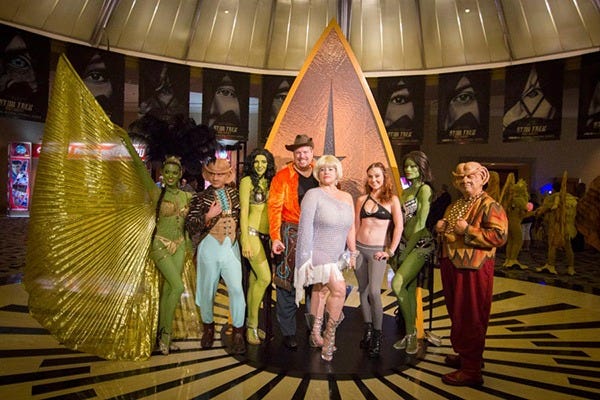
We think of fandom as loud. The word “fandom” conjures all sorts of images: conventions, cosplay, and yes–scores of Trekkies. Fandom and identity expression are intrinsically linked. But the loudest fans are not necessarily the most devoted, or at the very least they don’t account for everyone in the fandom who is. Fandoms seem monolithic, but individuals within them know there are many nuances. But silent fandom, having affection for something that the fan doesn’t advertise or demonstrate, can be the purest love. Without public performance, or the pressure of such, fandom is stripped to the very essence of why we love something: because it speaks to us on an individual level.
Is fandom, by definition, a group activity?
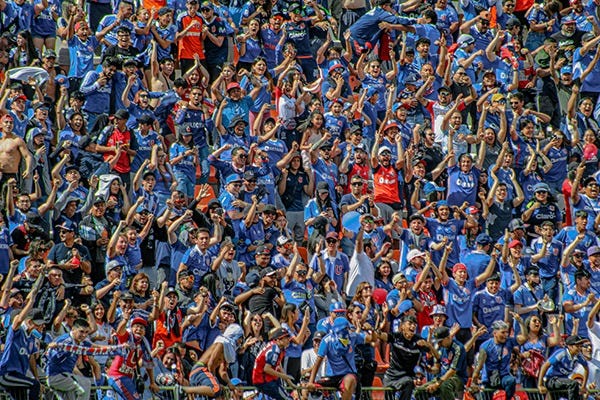
When we think of fandom, we think about it in terms of a collective experience. A fandom is not an individual, it is a group of individuals, either connected or not. You can be part of a fandom but not know anyone personally in it, but participate with the community anyway. Every time you go to a concert, or attend a movie, you are participating in fandom, with others, even if you’re alone.
Henry Jenkins, scholar of media and known as the founder of fan studies, asserts in his 1992 book, Textual Poachers: Television Fans and Participatory Culture that fandom is a group process. Fans interpret content together through shared conversations and create content for collective distribution like zines (today it might be a Reddit thread or a podcast). To be a fan is to inherently join a community, a collection of folks who build meaning together.
But if you love something, do you actually need to commune with others to consider yourself a fan? Jenkins, at least during the writing of his first book, might argue yes, because he makes a distinction between simply liking something and being a fan. The former might be private, and the latter requires others.
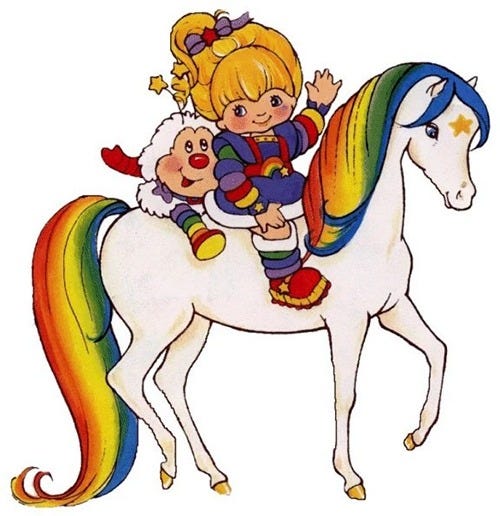
Fandom and identity often go hand in hand. Even as children, what we like is part of who we think we are. I remember being obsessed with Rainbow Brite, a cartoon character who wore a colorful dress and rode a horse with a rainbow mane. She also had blonde hair, which I desperately wanted at 5 years old. Somehow, this magical girl who brought color everywhere became part of my identity. I definitely couldn’t form any real conversation about her with other fans; to me she was just my friend. I played with the doll I had of her while I slept on sheets with rainbows on them.
As adults, I would argue that we participate in fandom, at least financially, without having to make it much of a group activity. We buy merch, rewatch things we love, maybe buy all the books from a favorite author without ever thinking about whether or not others love them too.
The tyranny of consensus
I personally think Jenkins is right about fandom transforming our relationships to the things we like through community and communication. He wrote about how the consensus of meaning is a collective, ongoing process that a fandom takes on naturally. In community, close readings and discussions can change the way we view a piece of content, simply because others have opinions that we are exposed to.
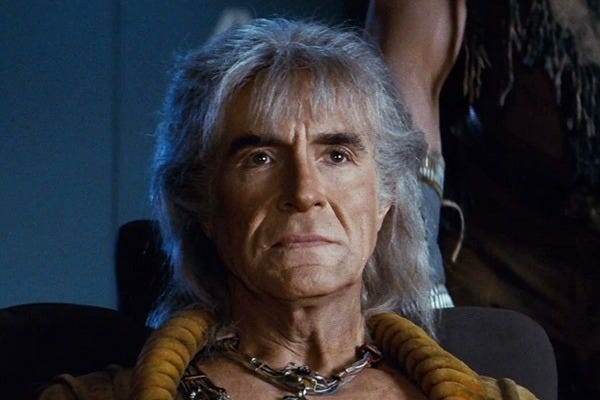
Participating in social fandom means that there will be a consensus to consider, one we might not want to. How we describe content is important to fandoms. There is canon, the official works of a franchise, and then there is “fanon,” the agreed-upon canon amongst fans that maybe explain plot holes or assert some kind of meaning. There is also beta canon, referring to licensed material like book series or podcasts associated with a franchise. Beta canon can stand until it is overwritten or contradicted by a piece of media in the official canon, and of course this is a great source of debate for a fandom. The Star Wars and Star Trek franchises have tons of associated, licensed novels that exist as beta canon. In 2025, the scripted podcast miniseries, Star Trek: Khan launched, written by Star Trek novelists and TV series screenwriters. It even features actors George Takei (reprising Sulu from the original series) and Tim Russ (reprising Tuvok from Star Trek Voyager). But it was still considered beta canon until writer Kirsten Beyer confirmed in an interview that the events of Khan would be considered–and not contradicted or overwritten–in all future Star Trek storytelling.
What happens when a community gets new information and makes a collective decision about a franchise that affects the fandom? Fans might feel pressured to perform consensus to fit in, or have their own views heard. To reference one of my previous posts on unpopular opinions, I was a self-proclaimed Gilmore Girls superfan for over a decade before I met more than a few others who even watched it. To me, canon began and ended with the text of the show.
But in 2016 I learned that there were fan-teams for Rory’s various boyfriends: Team Logan, Team Jess, Team Dean, and it made zero sense to me. What did the boyfriends have to do with anything? It’s Rory’s story, and they are great side characters who come in and out of her life. But getting out of my fan bubble of one and becoming part of the larger fandom by talking to others, I had to accept that this was “fanon” and part of the business of talking about my favorite show. It’s a kind of tyranny of consensus: any conversation I get into about the show with other fans will eventually land on the Team question because it’s so ubiquitous in the larger fandom. At least now I know and can either have an answer ready or dip out.
A private fan doesn’t have to virtue signal to the group. Unpopular opinions without an audience are just…opinions. Fans who celebrate in isolation don’t have to prove their level of fandom, as often happens in groups. Fans posture in a group setting, proving their worthiness as a “good fan” through various measures of legitimacy that the fandom has decided on. The revelation that I’d never thought about Rory Gilmore’s boyfriend Teams made me feel like a bit of a “bad fan.” There was a whole discourse I was missing simply because for me it never existed. But before I attended any Gilmore Girls events or discussions, I was the world’s biggest fan, at least in my own mind. I’d seen it more than twenty times, could recite every episode and identify most of the pop culture references. I liked being able to have my fandom without performing it. But actually participating in the community of the fandom is an entirely different experience, with its own traditions and rituals.
Separating art from artist
Relationships are hard. Even parasocial ones. Maybe especially those ones. When an artist or creator does something that doesn’t sit well with us, sometimes we have a hard time unwinding the art from the creator, especially in big fandoms with lots of voices and conflicting opinions.
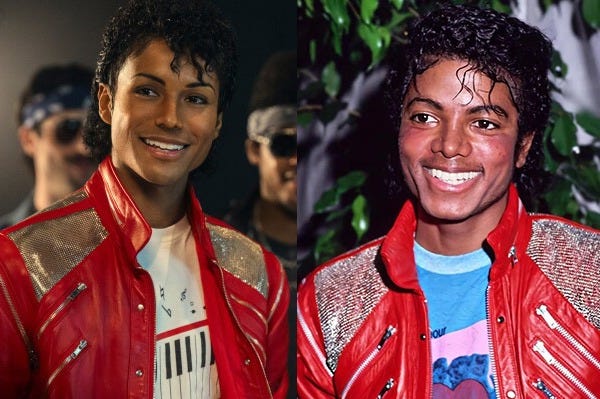
I recently saw the biopic Michael, a film about Michael Jackson’s early years as an artist through his superstardom into the late 1980s. I’ve also seen–twice–the Broadway musical MJ, a depiction of Jackson’s career told in flashbacks during the rehearsals for his Dangerous album world tour in 1992. Neither the film nor the musical address some of the more serious allegations towards Jackson, but do show an empathetic view of his growing addiction to painkillers following a terrible accident on the set of a commercial for Pepsi.
I always struggle to talk about my fandom for Jackson, but ever since I was a kid I’ve loved the music. One of my earliest memories was my mom playing “ABC” by the Jackson 5, on the 45 record in her collection. I viscerally remember the Motown logo on the label. My brother and I, along with friends of ours, did a skit and danced to the song for our school talent show, choreographed by our mothers. And as I got older, I listened to Michael Jackson on my own (and who didn’t love “Will You Be There” off of the Free Willy soundtrack? Shoutout to the elder millennials). In my freshman dorm suite, one of my roommates bought a vinyl copy of Bad and hung the cover sleeve on the wall in our kitchen as decoration. For two semesters I made my morning coffee with Michael looking over my shoulder.
On the one hand, both the stage show and the movie offer incredible portraits of sheer talent. I absolutely loved the musical; it was full of amazing dancing from Michael’s choreography, and the music is infectious and nostalgic. The spectacle of it made me sad that I didn’t see the Dangerous tour (probably because I was a preteen at the time). I found the biopic enjoyable too, and caught my young niece looking up the songs on her phone after we left the movie theater. The music is just so good, even Gen Alpha is into it.
Between Michael’s natural stage presence and his ability to draw on many dance inspirations from Fred Astaire to Fosse, to his commitment to transforming music as the culture knew it with the help of Quincy Jones, this is an individual it’s simply hard not to root for in the context of these pieces about his life and work. And I can’t imagine there is anyone who doesn’t feel the need to get up and dance when they hear the first beats of “Billie Jean,” or feel completely moved by the “Thriller” music video. It’s hard not to love the art and the artist by association.
But in light of the allegations, I am conflicted. Because even in looking up reviews of the movie, I saw lots of commentary on what was missing, and what might be addressed in the sequel in the coming years. Surely people have boycotted the movie and refused to see the show, and I understand why. But saying I loved both, and also love the artist’s work, is a tricky admission, depending on the setting. Instead of talking about the art, the conversations around the artist take center stage, and maybe they should. And on the flip side, inside the fandom, fans heavily contest the allegations and stand firm by his innocence. It’s hard to be a fan and hold contradictions inside a community, especially when you disagree.
Quiet fandom helps dispel some of that noise. You don’t have to publicly make a statement that you don’t agree with the artist, and still love the content. But more than that, without the noise of a fandom community, you can decide what you really think about both art and artist. Holding a contradiction is sometimes easier to do quietly. Fandom as a community tends to devolve into groupthink; this is an area where an individual can make their own decision without social risk.
The truest fan
There’s another scene in Gilmore Girls where Luke makes another geeky admission. Lorelai references The Twilight Zone, talking about her morning, and Luke responds that she could use The Outer Limits as a reference, because it’s a similar show from a similar era, but nobody ever references it. As Lorelai would say, “nerd alert!” What I love about Luke’s fandom for sci-fi is that it’s so unexpected and yet so pure. The Star Trek tee, the casual reference to The Outer Limits–both of these add up to a glimpse into a character that we never get to see fleshed out.
But we don’t see Luke at Comic-Con because he isn’t performing his fandom for others. And maybe that’s a sign of true fandom: not letting anyone else’s interpretation get in the way of your own passion for something. (Though it could be fun fanfic to follow Luke to a sci-fi convention.)
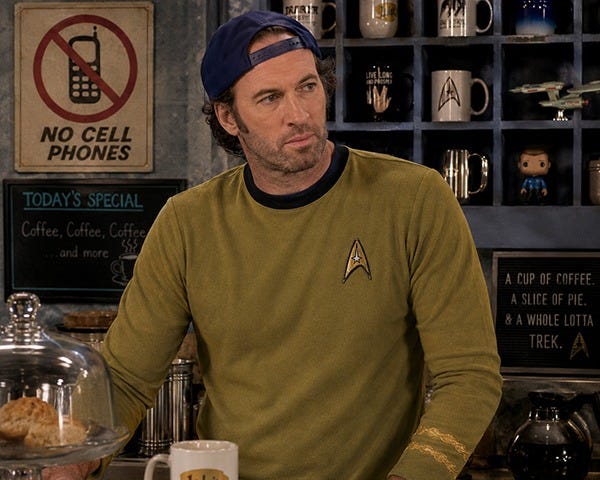
Maybe devotion to a franchise or musician or storyworld can be defined as the quality of attention, versus how loud and performative your attention is. And one can certainly be devoted to the highest degree in a group or alone. But whether you wear your Star Trek tee under your outfit in secret or proudly at a convention, what you love is part of you.
Want more? Our Discord is where you’ll find everything you need to know about the Remarkist ecosystem including Folkic, our community app and Masslore, our fandom knowledge database! And be sure to hit that subscribe button so you never miss a thing at Rmrk*st Mag!
