




I remember the first time I heard the question asked: “Team Dean, Team Jess, or Team Logan?” in reference to Gilmore Girls. I was listening to a podcast, and the hosts were asking a guest the question, “What Team are you on?”
I was really struck by this. Were there “teams” of fans who preferred a specific romantic match for Rory? (I realize now that this is a ridiculous question. It was 2017. Go with me here.) In all my years of watching and rewatching the show, I never once–not once!–considered any of these partners significant to the story of Rory’s development beyond what any relationship in one’s life does to further their evolution as a person. In fact, the main reason I had always loved the show was the mother/daughter/granddaughter relationships, and how the writers always centered these dynamics. It seemed so clear to me that the central thesis of the series was about generational bonds. All boyfriends were simply steps on Rory’s journey, nothing more.
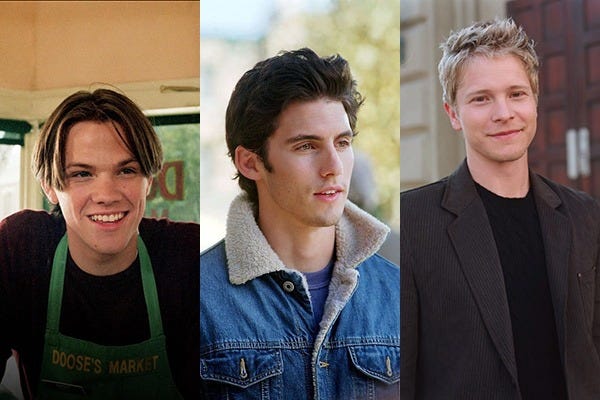
When I attended a virtual watch party of the series in 2021 and subsequently attended an in-person fan festival later that year, I realized my opinion on what the show was about was not actually that popular. Fans had formed actual teams around Rory’s boyfriends, had an opinion of which was her best, and discussed them at length. Meanwhile, I was wondering why they were even worth discussing at all.
My unpopular opinion was (and is!) that the show isn’t about romance or partnering up in the slightest, and the three boyfriends serve Rory as one of two main characters of the show whose story we are meant to care about (the other being her mother Lorelai). Her boyfriends’ character arcs aren’t important, but rather they exist to show us how her personal growth ebbs and flows over the course of her young adulthood. Therefore, picking a “team” seems strange to me, at best.
We’ve all been here. We’ve all said the one thing that other fans don’t generally agree with. On social media like TikTok and Reddit, unpopular opinions and hot takes abound. There are countless “unpopular opinions” threads on the Gilmore Girls subreddit. The “unpopular opinions” hashtag on TikTok is extremely, well, popular. Disagreement on social media fuels engagement, making posts go viral, which is why we see more and more of it.
But what exactly is the function of an unpopular opinion? Contrarian statements and hot takes in fandom spaces definitely spark drama, but that’s not all they do. When used in the most productive way, they lead to incredible conversations and deepen our engagement with the stories and franchises we love.
What exactly is an unpopular opinion?
Think about your favorite franchises, books, and movies. What characters, storylines or relationships are beloved within those franchises? Which ones hit you a bit differently? And how does it make you feel?
Fandoms are in-groups. They are distinctive social spaces with their own social norms; writer and fan expert Allegra Rosenberg goes so far to call fandom “an altered state.” Whether you participate in them virtually, in person, or both, in any specific community we all want to feel heard and respected. We all know what it feels like to drop a comment we really believe in and get no response. Or worse, a pile-on of negative “no, you’re wrong” arguments and downvotes. Does it make us feel like less a part of the group? Often it does. Or, it feels antithetical to the social contract of being inside a fandom.
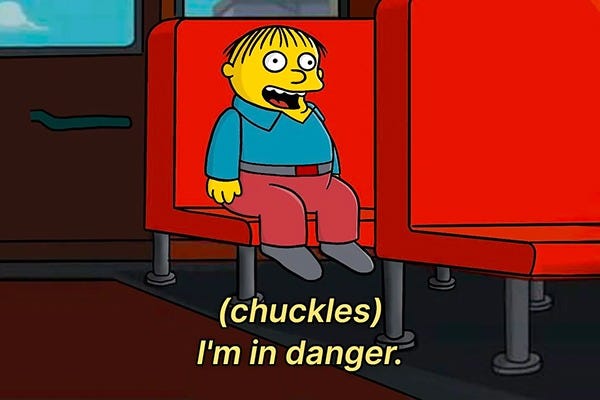
Social media has trained us to look for likes and echo chambers; it’s nice when we feel everyone agrees with us. So the unpopular opinion might be a surprise, and it can sting a bit. When your opinion clashes with the majority, it can feel like a rejection of you, not just your take. Fans often tie their identity deeply to the media they love, so rejection of an opinion can feel personal.
This is also why fans might form solidarity around teams (as in: Team Dean, Team Jess, Team Logan). It’s less of a risk to state an opposing opinion if you know you stand with a faction of fans who agree. We are conditioned to align ourselves with others out of psychological safety.
In the 1950s, a social psychology experiment, the Asch Conformity Experiment, proved that in a social situation, you might second-guess a correct answer when inside of a group that disagrees. The 2022 television show Jury Duty proved this experiment to comedic effect; Ronald Gladden knows that his jury duty stint feels unusual, but he goes along with all of it anyway, not realizing that he is part of a giant fictional hoax. In the context of fandom, you might soften or retract genuine opinions under perceived peer pressure so as to not disturb your social standing in the fandom group too much.
In modern society, having a hot take, especially via the internet, can gain you a following. While in the past we had shock jocks on the radio who provoked public sentiment for entertainment value, today we have influencers and commenters who want you to disagree with them for likes and shares. Engagement in the comment section can help that creator make a living.
But is it really fan discourse if the point is the performance of disagreement? And does that then make the opinion itself…popular? There is a difference between contrarianism for clout and genuine disagreement. The latter is what helps us build relationships and media literacy.
Genuine dissent can drive meaningful fan discourse
Fandom is definitely fun when everyone celebrates a franchise together. But inside of a fandom, things get really interesting when fans have genuine debates.
Recently when The Devil Wears Prada 2 hit theaters, there were tons of mixed to negative reviews from major outlets. While every critic seemed thrilled to see the stars of the iconic original back on film together, lots of opinions played down the actual story. Even some of my friends weren’t really into it and had complaints about Miranda being too soft, or Andie not seeming authentic as a journalist. I didn’t agree: the setting of a very different media world than the one we collectively experienced in 2006 would absolutely produce a softer Miranda. New media (websites, blogs, social media, etc.) changed traditional magazine and periodicals culture–and the creative titans that ran them–forever. So one hot take review caught my eye: A PureWow piece entitled “Sorry, You’re Wrong About ‘The Devil Wears Prada 2’ – That’s All” reflected all of my own unpopular opinions. This excerpt in particular:
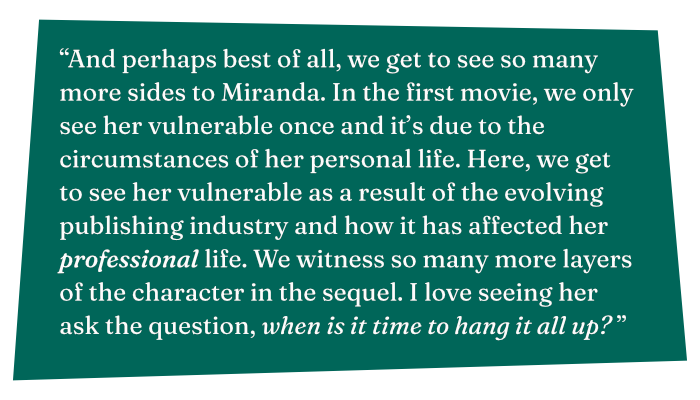
This was my “hot take” too, and led to some really interesting conversations with friends about many topics: the state of media (a profession I became part of in the 2000s), aging, professional growth, the way technology changes culture and jobs, and legacy.
A person can make a lot of noise when they hate on content just to hate. Especially when it’s popular. In modern times it’s even rewarded via social media algorithms. And, let’s be honest: we’ve all vocally hated on something without much critical thought; friends in my orbit who unequivocally hate Taylor Swift without engaging with her music in a deep way come to mind. And yes, I do it too: I can think of a time where I said I thought Grey’s Anatomy was a bad show to friends and they all took offense (I watched the first season and never went back). Hot takes without thoughtful critique is common, even within fan communities that turn toxic with infighting. But when both parties come to the conversation in good faith, rather than hating just to criticize, the outcome is a deeper discussion about personal values, experiences, and worldviews. We might even learn something.
Priya Parker, an expert on socializing and author of The Art of Gathering, wrote a piece recently in defense of “skunk guesting.” Drawing on the phrase “the skunk at the garden party,” Parker attempts to name the phenomenon when a guest doesn’t just stay quiet and polite when invited to a gathering, but instead uses their invitation to say something provocative in a room full of people who are the prime audience. She writes, “It’s the choice to use your temporary belonging — your seat at the table, your proximity, your invitation — not just to enjoy the room, but to shape it. To widen the geography of conversation. To interrupt, when necessary, in service of a larger value.” A hot take in a room full of invested parties carries weight; it’s the perfect place to confront a topic that might ruffle some feathers.
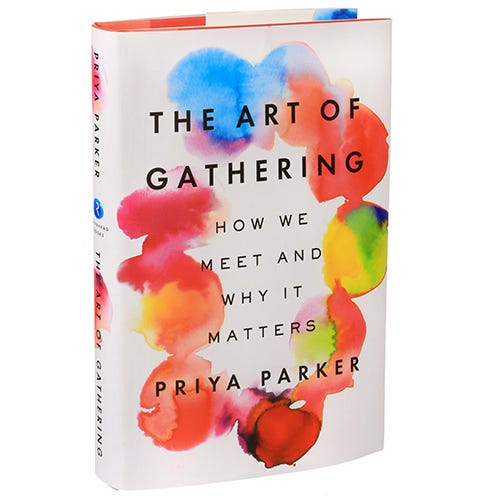
If a given fandom is the gathering, the person with the unpopular opinion is, well, the skunk in Parker’s metaphor. And to her argument, that unpopular opinion has the ability to shape the room in a way it might not have been if something went unsaid. And chances are, the person who chooses to voice a hot take is not the only fan who possesses it; they simply might be the bravest to speak it. And being forthcoming can inspire others to join in, resulting in a much more dynamic room.
Furthermore, fan discourse that emanates from one person’s unpopular opinion informs more dialog because the argument itself begs a rewatch. If I hear a hot take I don’t agree with, I might go back to rewatch from that lens and see if I can see the unpopular opinion holder’s point of view. Even if my opinion doesn’t change, if nothing else I at least attempted to see someone else’s point of view (and we can all argue that’s generally a good thing). We are all entitled to change our opinions, too, so discussion after a rewatch is a great way to reexamine our thoughts on any piece of content.
Unpopular opinions challenge stan culture
Mainstream narratives serve a purpose: they get folks interested, help content gain fans, etc. But sometimes blind love goes too far.
In the year 2000, I was in college and “Stan,” by Eminem was an enormous hit. Eminem became famous while I was in high school, and I was extremely aware of his influence. The song was about a fan whose love of an artist turns dark; Eminem named the fan Stan in the song, but we can take it as a portmanteau of the words “stalker” and “fan.” Before “Stan,” we didn’t have a word for a kind of fan like this, and to hear young people use it now in conversation when they love a creator (as in, saying “I stan this musician!”) for some of us, it’s a bit triggering. The concept is hardly new; I’d been a teen when superstar Selena was murdered by the founder of her own fan club. But this new word for it has transformed in the past twenty+ years of fandom culture.
Obsessive and parasocial superfan relationships to actors, musicians, and other famous people have existed as long as I can remember. Social media has amplified the phenomenon, giving fans unprecedented access to the celebrities they admire. But what about superfans of a series or character?
In fandom spaces, ship wars, character assassination, and cancel culture all exist when it comes to fiction. Ship wars, for the unfamiliar, are intense disagreements within fandoms over which characters should be romantically entwined. Fanfiction spaces like AO3 are havens for fans to build their own fiction around the characters they love, but heated debates over which they choose to romantically pair together can erupt all over platforms like Reddit, Twitter/X, and Tumblr. In many fandoms, shippers choose sides and stay pretty loyal, and encounter what one fanfic writer of “Reylo” fanfic (the shipping of the Star Wars franchise characters Rey and Kylo Ren—it’s ok if you didn’t know it; I had to look that one up) called “shipping prejudice” from other fans.
When it comes to cancel culture in a fan community, those who have differing opinions face aggressive call-outs from others who don’t agree with their takes. While disagreements can foster conversation, there’s a fine line between healthy debate and toxic policing of fandoms by others within it. It’s not uncommon for fans who go against the grain inside fandom spaces to face some drama, bullying, or worse. Again, this is tied to identity and belonging: our fandoms are part of who we are, and when others present opinions that don’t align with the ones we believe inside a fandom, it can feel threatening. And the entire reason stan culture and fandom toxicity exists is because of an intense emotional connection to the stories and creators we love.
Unpopular opinions enrich the fan experience
Healthy debate stemming from unpopular opinions are great for fandoms. And maybe the platforms we are used to using just aren’t great for thoughtful fan discourse. Social media favors outrage, and takedowns are swift. So finding a space where all opinions are welcome is key. To reiterate Priya Parker’s thesis, a gathering where one feels free to be the skunk might be the most valuable room.
To take it back to Gilmore Girls, the podcast I was listening to when I first heard about the existence of the boyfriend “teams” was Gilmore Guys, hosted by Kevin T. Porter and Demi Adejuyigbe.

The two guys came to the show from a totally different perspective than I had, so listening to their podcast as it dropped week to week was an exhilarating, frustrating, often screaming-out-loud-to-nobody-about-how-wrong-they-were endeavor. By the end, I had heard all of their hot takes, disagreed with many, and was fascinated by their read on a show I thought I knew well. I walked away from every episode enlightened, realizing my perspective was limited.
The best fandoms aren’t echo chambers. They are fertile ground for conversations that need thoughtful unpopular opinions and hot takes to stay alive. I’ve made some of my best friendships by debating their hot takes. When we embrace diversity of thought, challenge ourselves to find out-of-left-field opinions on the media we love, we stay open to the possibility that an unpopular opinion could lead to deeper engagement with our fandoms, and friendships with others within them.
Want more? Our Discord is where you’ll find everything you need to know about the Remarkist ecosystem including Folkic, our community app! Don’t forget to follow us on Instagram, tumblr, and Spotify for more insights on fandom—and hit that subscribe button so you never miss a thing at rmrk*st Mag!
