




When I was a preteen, I was obsessed with Boy Meets World from the moment the pilot aired. We had recorded one of the episodes on our trusty family VCR, probably because we had plans on the night it aired. Back then, if you were going to be away from your television when a show was on, you were going to miss it. (The VCR really changed our lives.) I remember when I got my hands on the tape and pressed play. This wasn’t an episode like the first three that had already aired. Season 1, Episode 4 was what would become one of the series’ most iconic: “Cory’s Alternative Friends.” If you’re a fan, you know the one. Cory, a curly haired boy, overhears a couple of girls talking about a classmate’s hair, calling him “a total Brillo head.” Cory assumes they’re talking about him and gets self-conscious, so attempts to straighten his hair with his friend Shawn’s help. Shawn gets the straightening product from his “sister” Stacey, and things go horribly wrong.
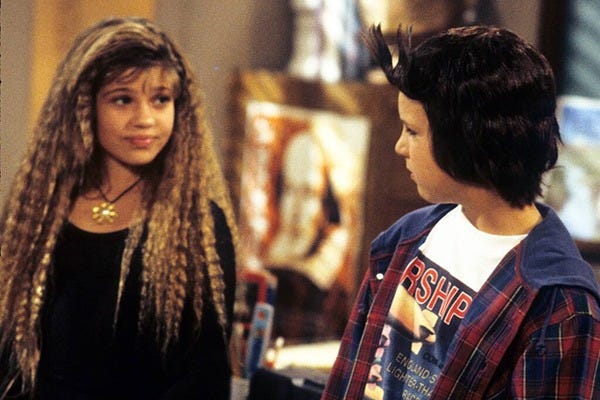
Cory’s hair looks ridiculous. And so, because this is middle school, he has to sit with at the “Weirdo Table,” consisting of a group of misfits. In the meantime, he is assigned to work on a project with Topanga, a hippie child who comes on strong and is a bit strange (though I would argue she’s stylish, environmentally conscious, and emotionally intelligent which is pretty cool). The episode culminates with Cory joining the “Weirdo” kids and Topanga, who have all been kind to him while he’s been publicly shunned for his hair, in a meaningful protest to attempt to save the school librarian’s job. At the end, Topanga kisses Cory at the lockers (and 12 yr old me lost her MIND).
Over three decades later, this episode is still a fan favorite. The show went on to have 7 seasons, and its major storylines included Shawn’s family life and Cory and Topanga’s romance. I bring that up because while this episode is iconic, it sets up facts about the characters that are never addressed again: namely, Shawn having a sister, Topanga’s parents’ hippie-ish names, and Topanga and Cory having zero relationship as of the 6th grade. The subsequent seasons go on to focus on these characters and these specific relationships, but these establishing facts are forgotten or overlooked for the duration of the series. It’s a point of fan contention that Cory and Topanga’s origin story changes again and again as the writers insist on their destiny as life partners, having met as babies on the playground.
On their podcast, Pod Meets World, actors Danielle Fishel and Rider Strong, who played these characters, often joke about how ridiculous it is that these plot holes abound. But for this fan, it’s refreshing to hear them talk about it. While plot holes are narrative failures that exist for all sorts of reasons, they are nevertheless invitations for discussion. For Fishel and Strong, they use these plot holes to speak to the realities of showbusiness, what the writer’s room dynamics might have been throughout the seasons, and their own understanding of their characters as the show progressed as they wondered about season renewals every year. All of these topics are insightful for fans to learn about. For regular fans with no personal connection to the production of content, plot holes offer an opportunity for us to question our relationships with fiction. What are we willing to overlook for the sake of story? And what really matters?
What is a plot hole, really?
Inconsistencies plague fiction all the time. Observant fans pick up on continuity mistakes and anachronist errors (or even just production errors) often. Many shows start with a pitch bible that leads the series through at least early seasons. A show bible contains lengthy character outlines and story arcs, defines the rules and facts of the story world, and sketches a progression of how the series will evolve. Writers refer to these documents when breaking new stories or pitching scripts.
Sometimes overall plot is stronger than details, and characters are rewritten either in their history or relationship to others. These plot holes feel almost intentional to serve a greater purpose, as it seems to have happened on Boy Meets World. Or on a soap opera or telenovella, continuity is sacrificed for drama all the time. It’s more compelling to have someone come back from the dead or reappear as a long lost sibling than the more realistic version, or one that adheres closely to past events in the narrative.
And when a series goes on for longer than the original writers intended, plot holes might be inevitable. The X-Files ran for so long that a lot of things didn’t make sense after a while, and not just because it was a sci-fi series where you’d expect unexplained phenomena.
Plot holes might even be subjective: what reads as a plot hole to one viewer might read as intentional ambiguity to another. Did the creators forget something? Or are we meant to clock it and wonder?
Why do plot holes bother us?
As humans, we are wired to try and make sense of everything we see. It’s one of our most native traits: before human civilization even existed, we created language and a means of documenting our observations about our surroundings. Plot holes mess with this innate need.
That nagging feeling that something is off can preoccupy your brain, losing you as an invested participant in the story. Plot holes can be frustrating, confusing, and even take a person out of the narrative experience.
Plot holes can affect our investment too. We might love a movie in spite of its plot holes, maybe even because of them. But an ill-placed plot hole in a series we’ve been enjoying for a while, especially if we’ve been previously impressed with its attention to detail, can really make fans angry. A series like Lost had a lot of dedicated fans in the beginning, fans who were so excited by the fact that it seemed the writers thought of everything, only to lose them when things started to make less sense and come out of left field. There is always a relationship between creator and consumer, and when that trust is broken, it’s hard to come back from.
It’s also possible that plot holes bother us as fans when we really love something, and don’t necessarily want to admit it is flawed. We all form deep connections to the stories we love, and as the saying goes, love is blind. Have you ever loved a movie so much when a friend says, “meh, I thought it was weird when….” and points out an inconsistency? Or when you’re watching something with someone else and their response to something on screen is “yeah, right, that would never happen…” you feel deflated? Plot holes might reveal that we either missed something big because we were too enthralled by the content, or that we are gullible and buy into something without reason. In short, a plot hole might reveal something about ourselves we aren’t too excited to confront.
Some fans are so bothered that they take plot holes into their own hands. They write fanfiction, or complete the story in a way they feel it should be completed, in an effort to correct a mistake, or what they perceive as one.
Why plot holes are great conversation starters
If you’re like me, your idea of a good time is discussing content and really digging into a close reading. But sometimes, a piece of fiction is just really wrapped up, and doesn’t ask, or compel me to ask, any meaningful questions. This actually frustrates me, as someone who loves to pick something apart in all the best ways, for great conversation. A plot hole is a perfect way to get a good conversation started. Shared irritation? That’s just another way to bond with other fans.
Let’s take Boy Meets World and the soulmates issue that drives the last half of the entire series and even inspired a Girl Meets World spinoff. Raising the stakes for Cory and Topanga’s love story might have meant sealing their destiny from the playground. But audiences might disagree. Is it more powerful for them to have met as toddlers knowing they would be together forever immediately (as much as one can know that sort of thing at 5 years old)? Or is it richer storytelling to reference the episode where we meet Topanga and get to know her as Cory does, and follow a linear love story from there? As a fan, I would argue the latter is a way more compelling love story: meeting a person from a totally different social group at 12, befriending them, and finding connection in the process provides endless story opportunities. But others might disagree, and prefer the destiny storyline. Whichever speaks to you as a fan might reveal something about your own thoughts on true love.
Inconsistencies can offer perpetual conversation. In Gilmore Girls, fans are constantly bringing up that the character, Kirk, played by Sean Gunn, shows up a couple of times in the earliest episodes before becoming a regular character on the show.
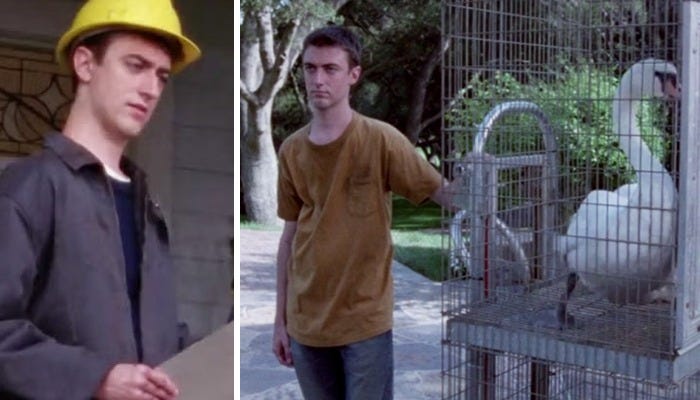
In one episode, he’s an unnamed swan delivery man. He goes by Mick in another episode, as a DSL installation technician. His name and origin story changes, as in later seasons we are told that other characters have known him his whole life, while earlier versions of the character feel like a stranger to the townies. But we could see Kirk as the DSL installation guy or delivering swans because his series-long bit is that he has many different jobs. There are many explanations given by the creators as to why this unfolded the way it did, but fans are still talking about it.
Entire communities form around plot hole discussion; a quick search on Reddit will show you many conversations devoted to the same writerly mistake. These plot holes sometimes unite and sometimes divide fandoms, but the fact is that they do offer some form of community conversation.
Plot hole? Or literary device?
Like I said, the human brain is wired to pick up on inconsistencies. So when we clock a plot hole, that might be the author or creator’s intent: to grab our attention. A deliberate gap might come back later.
As fans, it’s sometimes important to recognize the difference between an accidental plot hole and a point of mystery. One of my favorite story devices is when an event is glossed over in a narrative, barely noticeable, but the story comes back to it later. Whether seen in flashbacks, revisiting a scene from another perspective from another character’s point of view, etc. Anything that takes the viewer or reader back to fill the plot hole is so satisfying to me; coming back to a moment to explain it further or reveal what was really going on, or what someone saw, often offers a twist that instantly feels exciting. Intentional plot holes can be a lot of fun, especially when you like to be surprised or having your suspicions that something was off confirmed.
There’s also the plot hole that doesn’t resolve: an ending that doesn’t make sense or is open to too much interpretation. While this can be frustrating for fans, it might be the author’s intention to keep them guessing. A plot hole can set up sequels, more storytelling, leave them dissatisfied, or provide opportunities for retconning, which can really get people talking. It’s been decades and to this day fans are still discussing the ending of The Sopranos. Of course, one could argue if an ambiguous ending is a plot hole at all.
Embracing flawed stories
As for Boy Meets World, I can honestly say I was annoyed by the insistence on retconning the facts about characters I’d come to deeply love. But I kept watching all through my teens, until the very last episode aired. When I think of the series, I think of 12 yr old me, rewinding my VHS recording of “Cory’s Alternative Friends” over and over, guarding the cassette so nobody in my family would mistakenly tape over it, and now, I occasionally watch it on Disney Plus as an adult. I’m totally invested in hearing from the actors from the show on their podcast every week. The series meant everything to me because of that episode, and I can accept that future episodes pretty much assume my favorite episode never even happened. At the end of the day, the plot holes were no match for my devotion.
Sometimes we love something so much that plot holes cease to matter. A dedicated fan will notice inconsistencies, but accept them as part of the charm of the content. A gap in narrative is the gap where fans live: we thrive in the space between what the story gave us and what we needed it to give to us. Devotion to the content we love is deep and unconditional, and tracking flaws is evidence of how fully we receive stories.
Noticing a plot hole is the story’s way of telling you that you were attuned to it, that you cared enough to notice. A discussion about inconsistencies is in essence a discussion about our attention and where we focus it. While we watch a lot of content these days with one eye on our phones and our heads in many different places, noticing a plot hole might be a win in and of itself. It signals that we focused our attention on a fictional world for a bit of time, and isn’t that the point?
I want to hear about some of the plot holes that you love, that bug you, that fans discuss a lot or not enough. Share yours in the comments!
Want more? Our Discord is where you’ll find everything you need to know about the Remarkist ecosystem including Folkic, our community app! Don’t forget to follow us on Instagram, tumblr, and Spotify for more insights on fandom—and hit that subscribe button so you never miss a thing at rmrk*st Mag!

I love the movie “Signs” for so many reasons (#SymbolismAbounds). However, I always thought it was such an odd plot point/hole that these intelligent beings came to a planet that was 75% composed of an element that could kill them (even SG1 made a joke about it)!