




When it comes to thinking about stories, one thing I really love to do is critically reframe a character through an unexpected lens. In recent years, millennials have looked back at stories we loved as teens, and one sticks out. The 1998 remake of The Parent Trap, starring Lindsay Lohan, featured Lohan as the twins separated at birth to two different parents. In the movie, London-resident Annie switches places with northern California-living Hallie in order to get to know their respective other parents and eventually bring their mom and dad back together romantically.
When Annie (posing as Hallie) discovers their dad is engaged to another woman, their plan is ruined. But the twins hatch a new scheme: to scare off Dad’s girlfriend and prove she’s wretched, an “evil stepmother” type, and ultimately, not for him. (This is a kid’s movie, and it’s fun to think of 11-year-olds having so much power over the adults in their lives.)
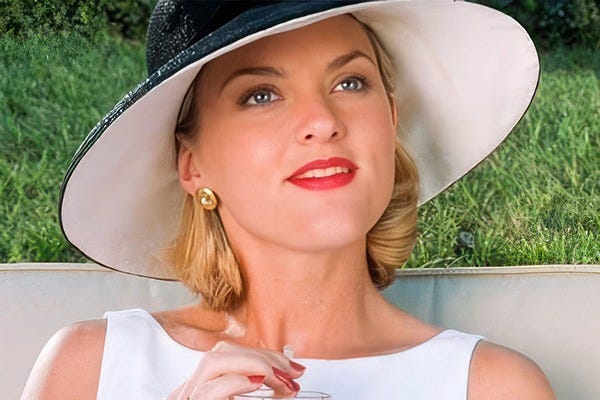
The girlfriend character, Meredith Blake, comes off as conniving, gold-digging, and uninterested in children or family–especially when I watched as a younger person. But what if you look at the story from her perspective? She meets a single dad with an affluent business who has a daughter. But after meeting her, she learns that daughter not only located her long-lost twin at camp but switched places with her, all under her beau’s nose. What kind of father doesn’t seem to notice that the kid he picked up at the airport isn’t the one he left at camp? And now his two daughters are hell-bent on torturing Meredith enough to leave him–which she doesn’t until she’s pushed extremely far to the edge. Looking at it through her POV, it’s kind of easy to take her side.
But more importantly, what if the thesis of the film can be read through Blake’s character? The central characters, twins Annie and Hallie, were put in an awful position by two adults who didn’t think very deeply about their future. Meredith seems to be thinking about her future as much as she can, while her fiancé can’t even tell his twin daughters apart. The theme of the movie seems to be: taking responsibility for one’s actions and needs isn’t fun or romantic; in fact, it’s considered villainous. So what does this mean for the rest of the film?
Villains are interesting characters because they help drive the action. And often, the villain serves to explain the rules of a world. Here are a few examples I wanted to take on.
The villain we dislike
When we watch a tv show or film, we’re immediately asked to support the hero or heroine of the story. We are introduced to the characters, setting, and plot through a particular lens. In The Devil Wears Prada, both the novel and the film introduce us to Andy Sachs, a struggling graduate who longs to be a journalist in New York. She ends up at the fictional Runway Magazine, where everyone she meets seems to hate her inexplicably (but probably because of her clothing and lack of poise). In this world, her intelligence doesn’t seem to matter at first–not if she can’t do a coffee run in high heels. The viewer sees the staff at Runway as she does: concerned about unimportant details like which belt to choose for a photo shoot, but they treat this decision as if it is a matter between life and death.
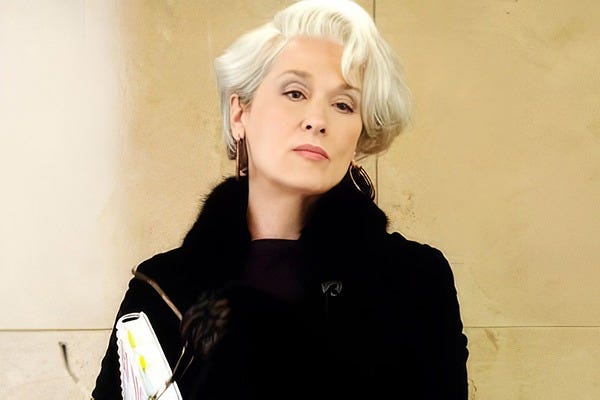
Editor-in-chief Miranda Priestly’s reputation precedes her before she makes an actual appearance in both book and film; the specter of her looms over everyone that works at the magazine. When we do meet her, Miranda is demanding, discerning, and powerful. Meryl Streep’s portrayal shows us a truly terrifying figure: soft-spoken in a way that could make your blood turn cold, and gives minimal eye contact–only when you’ve done something wrong. She isn’t interested in excuses as to why everyone in her office isn’t ready to present ideas, or even in getting anyone’s name right. And she doesn’t have to: she’s Miranda Priestly.
As an audience, we dislike her because, well, she’s not kind to anyone. Everyone exists to serve her every desire at the most inconvenient moments. And as a boss, she doesn’t give praise, say thank you, or even clearly ask for what she wants. Andy learns that to be successful she will have to literally read her new boss’s mind. But also, it all seems so silly: why does this one woman have a hold on the media industry and everyone around her? Why are they treating fashion like it’s hard-hitting journalism?
Of course we learn through the “cerulean sweater” speech that fashion IS important, and fashion journalism drives culture and commerce internationally. The Devil Wears Prada 2, its sequel, drew attention to the changing media industry as a whole and how that not only impacts fashion but the entire culture. Miranda Priestly might be a villain, but she’s holding an entire industry in the palm of her hand–and it’s a lot of pressure. She’s unlikeable and unknowable because this persona helps her hold onto her power and allows her to make the big decisions that will impact culture in the long run.
For Andy, her tenure as Miranda’s assistant is difficult, but through it she learns that the world doesn’t just hand everyone success: navigating difficult situations and expectations can lead us to great opportunities. Andy was immersed in a world she was unfamiliar with and thus learned to respect it. She was connected to important people in the media industry. She got to go to Paris! But every time I watch it, I see Miranda’s character as the embodiment of the story’s core thesis: Ambition has a cost. Being a woman in the media with a great deal of power might mean that you can’t actually have it all. It may look glamorous at the top–but it’s lonely.
The villain we admire
I’ve been a huge fan of Mean Girls since the day I saw it in the theaters. One reason is that I understood it completely: the archetypes of each character were spot-on, and I saw myself, my friends, my classmates and teachers all on screen. Regina George as the leader of The Plastics resonated with me: I knew who the “queen bee” was in every clique I’d ever been confronted with at school and extracurricular activities my whole life.
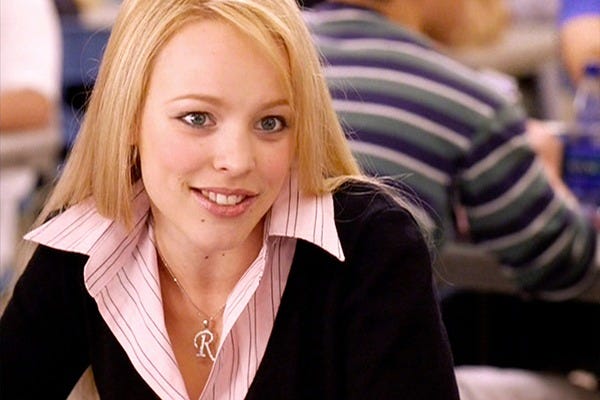
Regina George is presented to the viewer as somewhat of an evil entity, as she is introduced by the character of Janice Ian, who has a good reason to dislike her. We immediately dislike her too: though her first interaction with new girl Cady Heron is positive as she comes to her rescue when a boy is attempting to mock her, the audience understands that she might be insincere. She uses flattery and charisma to make people like her, even when she has no intention of befriending them. She also has a weird hold on where kids are “allowed” to sit at lunch. Everything for her is about power: her cult of personality allows her to make the social rules.
Throughout the film, Cady is tasked with befriending The Plastics in order to take them down in a revenge plot not just for Janice, but also for anyone else who has felt “personally victimized” by George. But as the film progresses, Cady’s focus on Regina turns obsessive and mean-spirited. Cady takes pranks too far, flirts with Regina’s boyfriend, and forgets her friend’s art show. So, who really is the villain?
Regina might still be a villain of the story, not because of who she is as a person but what she represents. The social hierarchy of girlhood–especially in high school–is tough to navigate as an adolescent. And because it’s so complex, girls find themselves playing roles that solidify their social status but maybe don’t constitute real friendship and support when they need it most. Everyone in the story takes their cues from Regina: they are “mean” to one another because that’s how they learn to exist in a system in which they feel they have to be. The social roles exist regardless of who inhabits them; when Regina falls out of “queen bee” status and Cady takes her place, everyone looks to her for the same guidance they once took from Regina. The thesis of the film is explained through the archetype of the “mean girl”: the only real fix, as the film states, is to eliminate the queen bee’s power by letting go of the social roles they feel destined to play, and to confront their own feelings with honesty. Everyone should be able to befriend whoever they want, join the Mathletes if they’re passionate about numbers without worrying about “social suicide,” and yes, sit at whatever lunch table they like.
The villain we root for
It can be confusing when we find ourselves rooting for the character it might be clear we’re supposed to think of as the villain. I think about this all the time when I watch Gilmore Girls. The character of Emily Gilmore is often set up as a foil to Lorelai. She is the mother who never understood her and pushed her away emotionally and physically, so much so that Lorelai had to find her own life in the magical town of Stars Hollow. And as a viewer, Stars Hollow is presented as light, free, and whimsical while the Gilmore mansion in Hartford seems dark, oppressive, and depressing.
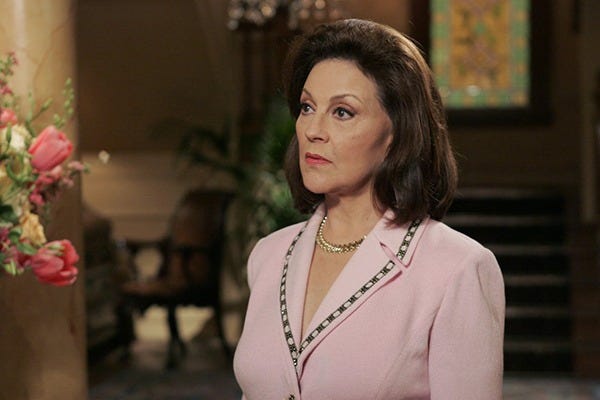
But the older I get, and the more I rewatch, I have come to understand Emily as a character who is not a villain but a product of her time: she wants Lorelai to be educated and get married to a man from a respected family because when she was younger, that was the key to survival and respect. She wants Lorelai to fit into her world because she’s protective. She also wants to pay for everything, like Rory’s school or extravagant gifts, because financial support equals love and stability in her world. Lorelai always feels stifled and misunderstood by her mother, and as viewers we are meant to feel that too.
But if you look closer, Emily’s misguided interactions with Lorelai always comes from a place of love–or her version of it. I find myself rooting for Emily all the time, and I believe her character sets up a thesis about the show: mothers and daughters will always have complicated relationships. A generational divide is ripe for misunderstanding, and the show itself is about what happens when mothers and daughters are best friends instead of adversaries. The series shows us all of the nuances of mother/daughter relationships through this one thematic thread.
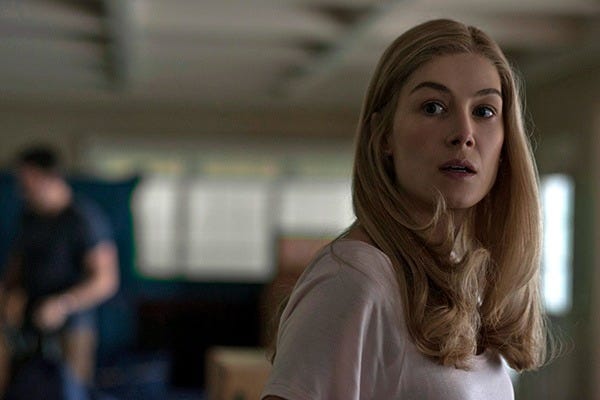
Another great example of a villain we root for is Amy Dunne in Gone Girl. When I read Gillian Flynn’s 2012 novel, I was blown away. *Spoiler alert here if you’ve never read it or seen the movie adaptation!* The first part of the novel focuses on Amy’s disappearance. The reader is asked to question whether her husband, Nick, is responsible for her disappearance or a victim of it. It is revealed that he’s been having an affair, and the police suspect his involvement in foul play.
But then Flynn pulls off the most flawless mid-novel twist: Amy is alive, and she has faked her own death to frame her husband as revenge. In one of the most memorable speeches I’ve ever read, Amy explains the myth of the “cool girl”: the effortless, attractive woman who is “one of the guys,” loves sports and never complains. She is endlessly accommodating but always sexy and fun. She explains that this female persona–one many women understand all too well–is born out of a misogynistic society where women are expected to be unbothered. And in this marriage, at least, being “cool” was what her husband loved about her, not that it mattered: not only did she lose herself, but her husband was unfaithful anyway. For the rest of the story, Amy does some awful things, so she is a villain for sure. But the audience roots for her anyway, as the character is asking the viewer to confront a very hard truth about the expectations placed on women, and watching her reject those expectations outright is cathartic.
Justice for Meredith Blake
Sometimes I wonder where Meredith Blake ended up. Did she find another rich business owner to marry? Did she ever have children of her own? Or did she go out with her girlfriends after breaking up with Nick Parker and tell them the horror story of how the guy she was about to marry lied about having a second child, then those children tried to ruin her life, and still she didn’t quit until she realized he was still in love with their mother? It sounds awful!
Still, her perspective–and the thesis of the film–is about truly insane choices on the part of adults: what right-minded adult meets a stranger on a voyage from London to America, gets married by a ship captain, has twins with that person shortly thereafter and breaks up, each taking one child to separate countries? Probably the same kind of adult who swoops in on a vineyard-owning bachelor while his kid is at camp and starts planning a wedding within weeks. It seems the only people in the film that have a firm grasp on right and wrong are the children themselves, so for a kids’ movie, it feels right that the kids in the film are the heroes who put everything back together as it should be.
So next time you’re watching a film or reading a book, think about the villain in the story and what their perspective is maybe saying about the message of the piece. I’d love to hear your thoughts in the comments!
Want more? Our Discord is where you’ll find everything you need to know about the Remarkist ecosystem including Folkic, our community app and Masslore, our fandom knowledge database! And be sure to hit that subscribe button so you never miss a thing at Rmrk*st Mag!
