



I spent a weekend completely binging a show on Apple TV that it seemed everyone was talking about: Widow’s Bay starring Matthew Rhys. Unlike his terrifying character in The Beast in Me, Rhys plays the almost deliberately aloof mayor of a small island town who, like the mayor of Amity in Jaws, is choosing to ignore some particularly troublesome mysterious truths about his home and the people that inhabit it.
I watched Widow’s Bay the way I watch most thrillers: with one hand over my face and the other on my remote, compulsively skipping the credits to get to the next episode. I simply could not stop watching, even opting to stop an episode halfway through to go to sleep and picking it right up with my coffee the next morning. It is about a New England town on a secluded island that has a truly mysterious and checkered past. From the first settlers reporting of evil happenings, to modern local fishermen fearing a certain point in the ocean, and a community still reeling from a killing spree of young girls, there’s a lot to be nervous about. It’s described as comedy-horror, and I agree that it is: the townies are delightfully quirky and deliver deadpan lines, briefly providing relief from the stress of the tension. The comedy helped me enjoy the series on one level, but the jokes also provided what I would call a Twin Peaksification to the dialog, contributing to the overall uneasiness I felt.
I am not a horror movie fan. I don’t do well with being scared, and I certainly don’t like blood and gore. Slasher films? I’m out. Zombies and monsters? Nope. As a self-proclaimed Highly Sensitive Person (HSP), certain images on screen stick with me and disturb my waking and sleeping moments for years. So, I avoid certain content for my own peace of mind.
But as a kid I realized the appeal of action thrillers, like Speed or The Fugitive. And psychological thrillers became intoxicating to me. I started to crave that not-knowing feeling about what might happen to the characters I grew attached to, and watching them wrestle with their own perceptions was a fun exercise that got me thinking about my own life and decision-making. I recognized this as an appreciation for suspense over horror. Shows like Lost and other narratives that dealt with more of a puzzle or mysterious happenings versus a serial killer on the loose were interesting to me.
It comes down to how my own imagination fills in details: what could be happening versus what we might find out is happening. And this imagination is cultivated on both a personal and collective level. Considering the runaway success of the movie Backrooms, collective imagination provides the scaffold around which thrillers can be built, and the audience becomes a collaborator in the storytelling. A slasher film might tell you exactly what to be afraid of, but good suspense–like hearing that eerie signature John Williams score in Jaws–has the viewer creating all kinds of things to be afraid of in their own mind.
Why the Imagination Scares Better Than the Screen
I viscerally remember the scariest book I ever read as a kid. I was a fan of the Sweet Valley Kids and Sweet Valley Twins book series by Francine Pascal, and all of the Sweet Valley franchises had a thriller series attached to the main one. Sweet Valley Twins had the Super Chiller special editions: these were longer books that had stylistically different covers, and something about them tempted me.
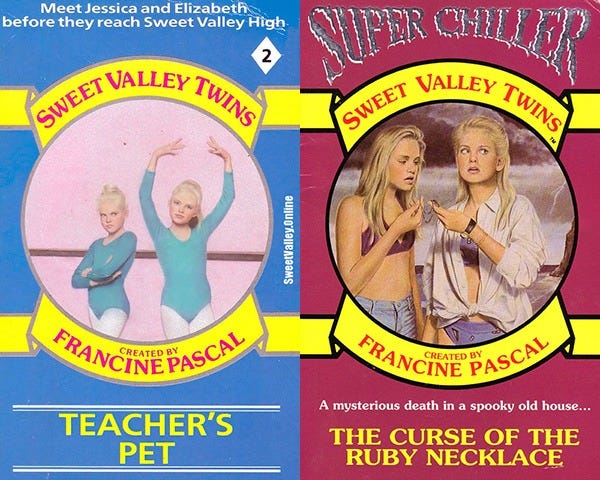
The one I read was The Curse of the Ruby Necklace, a thriller where Jessica finds a ruby necklace while filming a movie about a girl’s mysterious death at an old mansion. After finding it, Jessica experiences nightmares and supernatural activity. When her twin sister Elizabeth procures the necklace from her, she starts having the same nightmares and does some investigating, eventually discovering that the necklace belonged to the dead girl. It freaked me out considerably. I was about 11 or 12, and I still remember what I imagined in my mind’s eye as I read it. If they made a movie of this book, it would never live up to my experience of the read.
As an adult, the scariest book I ever read was Simone St. James’ The Broken Girls. A journalist is on the scene at an abandoned girls’ boarding school investigating the murder of her sister, when she uncovers a connection to the school’s past and a story of a lingering ghost that haunts it. The narrative jumps in time from the 1950s to 2014, and in the back and forth the reader learns about the students and what might have happened there. But the storytelling is gothic in nature, and St. James managed to scare the bejeezus out of me with supernatural elements, such as music turning on at random moments, and other ghostly activities. She did it again with her novel The Sun Down Motel, about a woman working as a night clerk who vanishes from a motel in the early 1980s and her niece who investigates the disappearance decades later. St. James has a knack for atmospheric storytelling that would keep me away from roadside motels for the rest of my life.
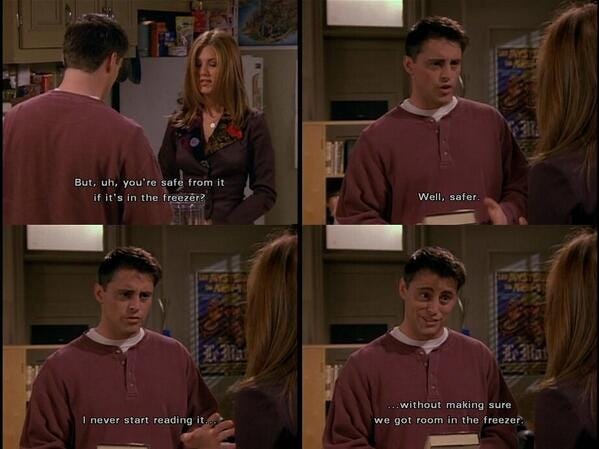
One of my favorite bits from the show Friends is when Joey keeps his copy of The Shining by Stephen King in the freezer. Why? So it can’t haunt him. It’s hilarious because it feels so relatable: a book is just a book, but sometimes the imagery it evokes in our own minds is so real that we can’t have it in the same room as us.
When we read, we conjure images and settings from the written page, and I believe we think up the scariest versions of those things that our minds will allow because we are effectively in a safe space. Research suggests that we might willingly dabble with suspense, horror, and thriller genres because it’s a way to experience fear about certain things in a “protected frame” or controlled environment. We feel physically safe (in a theater or in front of a screen, or on our couch reading a book), detached (knowing that the horrors on screen are fake, or characters in a book are made up), and confident in the controlled environment (a haunted house monster won’t outrun us).
Novels and other fictional spaces that we visit are collaborative between us and the authors and creators. We fill the blanks they leave with our personal fears, making the imagined threat more specific and potent than anything a creator could invent. When the story unfolds without showing us much–which happens naturally while we read since we can only go on the author’s descriptions, and more practically when we watch suspense that leaves a lot to the imagination through suggestion–our brains do the heavy lifting of manufacturing the scariest thing possible.
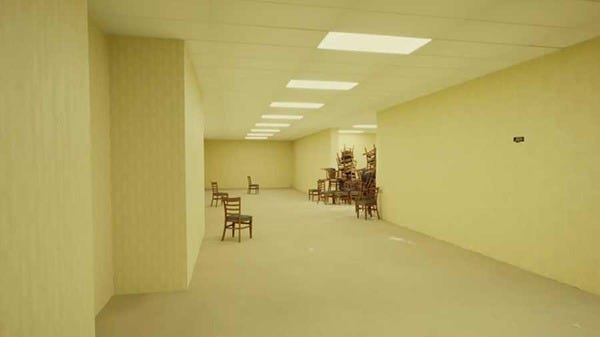
Backrooms took this concept and ran with it–all the way to box office millions. What started as a photo on a 4chan message board grew into a phenomenon of storytelling. When a user asked for “disquieting images,” someone posted a creepypasta of an abandoned office space. The image was an example of kenopsia, the idea that something ordinary could feel off in a particular context, like an empty, abandoned mall. The photo projects a liminal space, a transitionary place caught in between what may have happened in it and what happens next. A collective fandom grew around the phenomenon of “backrooms,” and YouTuber Kane Parsons built a series, called The Backrooms, around it. From there, YouTuber Kane Parsons built a celebrated series around the concept, which eventually inspired a full theatrical film drawing on the “found footage” genre of horror. The audience’s imagination does the rest.
Suspense Through Sustained Uncertainty
What I loved about Lost when it aired in the 2000s was the very fact that I had absolutely no idea what was going on. When I hear criticisms today about the show, the prevailing one is that certain plot points didn’t make sense, or never answered certain questions. But for me and other fans, that was the appeal. Every season introduced more questions than answers, and that left a lot of room for fans to discuss and theorize in between episodes and seasons. That was the most fun part, more than actually watching it. It’s what I remember most from the experience.
As I sat down to watch Widow’s Bay (and I promise no spoilers here!), I was confronted with some expected accoutrements of suspense: an isolated town, folks murmuring about mysterious happenings, kooky townies with weird stories. But episode to episode, I truly had no idea what “big bad” I was looking for; I just had a bunch of random puzzle pieces. The series bills itself as comedy horror, and while there are horror elements, the absurdity of these events and character one-liners are comical. Perhaps that’s what made it all the more creepy: the genuine moments for laughter almost felt misplaced.
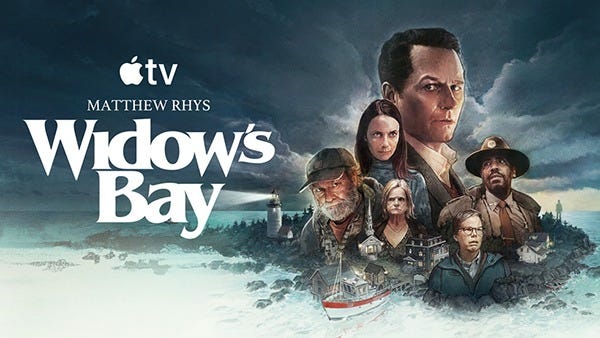
The effect is a viewer not knowing how to hold information, which is in itself unsettling. It’s also so unclear what’s going on: is the island haunted? Was there a serial killer? Are these ancient mysteries or is there something still happening now? When a story proposes many options, the viewer has to hold all of these possibilities at the same time, which sustains uncertainty and their need to use their imaginations to fill in obvious blanks. Episode to episode, it feels like you’re writing along with the creators because your brain keeps asking new questions and providing possible answers.
Widow’s Bay also heavily references other horror and suspense movies, like Stephen King’s It and Carrie, etc. as well as Jaws, The Fog, and more. These visual references help the viewer fill in the blanks as well by using the familiarity; cognitively we pull up memories of those stories and write the ending to this one. For example, we know what happened to Carrie, so maybe for a moment we expect this story to go the same way because we see familiar imagery that relates to that classic story.
In perhaps a mimicry of what it feels like to watch the entire series, one episode features a drug trip with periods of blackout that skip time. Imagining what happens in the interim is all the viewer has to go on. And in a way, the entire series is about learning to live with everyday horrors and uncertainties, and doing your best to move forward.
Community of Imaginations Fuel Suspense Narratives
Suspense stories that withhold information don’t just scare and perplex individual viewers, but it generates community as people gather to compare and contrast what they imagined or think is actually happening.
This is where audiences really get to work. At the end of every episode of Lost, fans would talk to each other in person and online and wonder their fan theories aloud; there was no need for this to end when there were no more episodes. Upon the ending of Widow’s Bay (again, no spoilers!), I thought about the questions the series posed. There is a second season coming, but even if there wasn’t one, I think I’d still be having as much fun as I am now discussing the possibilities with friends who have watched. Suspense and thrillers work because of collective imagination.
The Backrooms, both the online urban legend and the film Backrooms, are the ultimate proof of this in action. The original 4chan question asked for a photo and relatively nothing else, and the anonymously posted office photo prompted fans to fill in more blanks collectively. A user responded that you could “noclip” (a video game term for cheat code to bypass limits of the game) and the storytelling went viral from there. Soon various subreddits and creators expanded on the idea, even creating a split in the fandom between “true” backrooms and new levels. The phenomenon was so popular and widespread, even Severance creator Dan Erikson said he was inspired by the Backrooms for his series. This is reminiscent of the Goncharov phenomenon, where fans created a myth around a fake film.
The power of unanswered questions
As humans, we crave endings that tie up loose ends. I always hear complaints from fans when an ending is abrupt, or ambiguous (cue Gilmore Girls: A Year in the Life’s “final four words”). Unanswered questions leave audiences desperate for more information. The sustained ambiguity throughout the content up until the end has held their rapt attention precisely because they feel they’re getting close to a conclusion. Uncertainty is unsettling.
But our imaginations come in to help us make sense of the world. It’s why we turn to stories in the first place. We are brought up on narratives that have beginnings, middles, and endings. “Once upon a times” are followed by “happily ever afters” because we like to make meaning out of life’s events. Clean endings, regardless of whether they’re happy or not, are hard to come by in the real world.
When we engage with suspense stories, our imaginations get a good workout. We exercise problem solving, look for clues, consider wild possibilities, and build community. As children, we engage in imaginative play all the time, preparing us for future activities as adults. But as adults, we don’t use that muscle in everyday life as much as we probably could. So the next time you’re sucked into a thriller, think about how your brain is activated, and how this might help you in your very real endeavors. You just might imagine something unexpected.
Want more? Our Discord is where you’ll find everything you need to know about the Remarkist ecosystem including Folkic, our community app and Masslore, our fandom knowledge database! And be sure to hit that subscribe button so you never miss a thing at Rmrk*st Mag!
