



I marvel at the popularity of Dancing with the Stars. The competition show famously pairs professional ballroom dancers with “stars” and over the course of the competition, they teach them several disciplines within the world of ballroom dance and each week they compete for judges’ scores and audience votes. Each week, there is a theme around the dances and songs chosen, like Halloween or Disney. But each season there is one night that has become tradition: Dedication Night.
It’s a beloved exercise that fans love: each star gets to pick a person or entity they want to dedicate their week’s dance to. In the same night this season, a contestant dedicated their dance to a former costar who has passed away. Tatyana Ali, who became famous as a child star of The Fresh Prince of Bel-Air, dedicated her dance to the late James Avery, who played her father on the hit sitcom and was a dear friend and mentor. And actress Julia Stiles dedicated hers to the late Heath Ledger, her costar from 10 Things I Hate About You.
The dedication made sense to me as a huge fan of the movie. I was a senior in high school the year 10 Things I Hate About You came out, the same age as Stiles was when she filmed the movie. The cast featured child stars my generation already loved: Joseph Gordon-Levitt, Larisa Oleynik, Andrew Keegan, Gabrielle Union, and David Krumholtz. These were faces we grew up with, all supporting two relative newcomers: Julia Stiles and Heath Ledger. I viscerally remember sitting in the movie theater with friends, slowly realizing that Stiles and Ledger were about to be huge stars. Their chemistry was undeniable, their comedic timing and emotional moments infectious. It’s odd to be present for something that will become a pop culture phenomenon. You don’t know how much impact it will have on a generation, except that you’re impacted, which makes you part of the moment itself.
When Heath Ledger passed away in 2008, I was struck more deeply than I might be by news of someone else’s passing. His career had blossomed, and his later films, like Brokeback Mountain, solidified his place in Hollywood legacy. But even having taken on enormous roles that earned him prestigious attention, my thoughts were still with the young teen movie heartthrob who impressed and charmed me in 10 Things. I hadn’t thought about the movie in years, until Stiles chose to honor Ledger with her Dedication Night dance. They performed last, and at the end of the dance, several members of the cast of the film joined her on stage for a moment of solidarity. It was monumental for anyone in my shoes: a generation of fans who have collectively come together to not only mourn the loss we have felt together, but also geek out about a movie we loved as teens that made such an impact on our young lives almost three decades ago. Yes, the world mourned Ledger when he passed almost twenty years ago. But the fandom of this defining film hadn’t mourned together in this way until we saw the entire cast of the movie standing together, hand in hand.
Fans grieve losses collectively, through rituals, events, or renewed discourse. Musician Sara Bareilles’ latest album, Good Grief, is about several losses she has experienced, and throughout the tour for the album she encouraged fans to participate and grieve with her in a kind of group therapy. She even filmed a documentary, chronicling the recording of the album. The film is an exploration of the making of this music, and she goes into some detail about the friends and personal losses that she writes about. It’s a moving tribute both to the range of human emotion while going through profound grief, as well as to the process of making art that grief inspires.

Prior to the tour, Bareilles set up a grief hotline for folks to call and leave messages about lost loved ones, and she played some of the voicemails during the shows. The voicemails provided levity in between songs, and allowed everyone–communities of strangers gathered for each concert–to share in these individual stories of love and loss. Fandom has a way of anchoring individuals to a community, and grief is one reason fans come together.
Here are a few phenomena that speak to the role of community when fans collectively experience grief.
Dobby’s Grave, Harry Potter
The character of Dobby the house elf is beloved by fans of the Harry Potter book series and movies alike. In the series, Dobby first belongs to the Malfoy family. House elves are bound to their masters unless given clothing, so Harry frees Dobby from the Malfoys by tricking Lucius Malfoy into giving Dobby a sock. From there, Dobby can work–for pay–for the students at Hogwarts as well as aid Harry and his friends. Loyal to a fault, Dobby suffers a tragic end: he is killed by Bellatrix Lestrange while saving the lives of Harry, Ron, Hermione and the gang. In tribute, they buried Dobby on the beach in the movie, and in the books at Shell Cottage nearby, with an inscription: “Here lies Dobby, a free elf.”

Fans have been making a pilgrimage to the filming site of Dobby’s grave from the movies for years. The site is located at Freshwater West beach in Wales. Fans have put together step-by-step guides on how to get there, and what’s allowed in terms of tribute. The real filming site serves as a memorial to Dobby and the fans’ love for him. It is marked by a shrine of rocks, and fans used to leave items like socks in tribute. But, this being a beach, leaving articles of clothing disrupts the local ecosystem. The site was almost taken down completely, but it meant a lot to fans of the fictional character. So the National Trust Wales, which manages the beach, decided the shrine could stay, as long as fans stopped leaving other items. Making their way to the memorial is a pilgrimage for fans who love what Dobby stands for: loyalty, independence, devotion, and true friendship.
Richard Gilmore/Edward Herrmann
Actor Edward Herrmann was beloved for so many iconic roles both on stage and screen over his decades-long career. But his biggest fandom might just be because of Gilmore Girls. Herrmann passed away in 2014, seven years after Gilmore Girls was off the air. When news of a revival surfaced, fans wondered how the franchise would handle the loss of Herrmann, as a series without Richard Gilmore felt impossible to fathom.
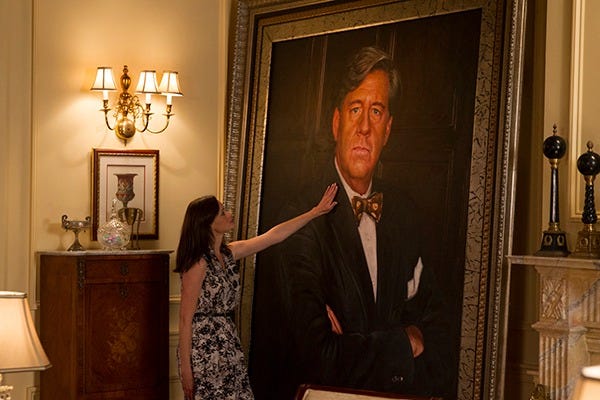
The four-part sequel miniseries, Gilmore Girls: A Year in the Life, which premiered in 2016, gave everyone a chance to say goodbye to both Edward and Richard Gilmore. Richard Gilmore’s passing was written into the narrative of the show, a plot point for Emily, Lorelai and Rory’s storylines and a larger theme about grief. From Emily deciding to pursue other interests after his death to Lorelai reckoning with the unresolved parts of her relationship with her father, as a viewer it felt like a catharsis. But because Herrmann himself is gone, it felt as if we, as viewers, could mourn his loss with the characters, but the actors that play them too.
Leonard Nimoy/Spock
Leonard Nimoy, famous for playing Spock in Star Trek, passed away in 2015. Immediately, fans took to the internet and generated creative memes in tribute to the character and the man behind him. The massive impact Spock has had on generations of fans is difficult to overstate. Not only has the character appeared across so many iterations of the franchise, including films, novels and comic books, but fans uniquely identified with him. As half Vulcan, half human, he represents “otherness” on screen; those who feel marginalized in their own communities have long looked to him for inspiration. He redefines the image of a hero: his approach is one of caution and intelligence. His sound mind and judgment balances out the dynamic between him, Captain Kirk, and Dr. McCoy. The “logical outsider” character archetype shows up in the media consistently from shows like Stranger Things to Dr. Who. Even non-sci-fi/fantasy shows like Community have a “logical outsider” character that is partially influenced by Spock.
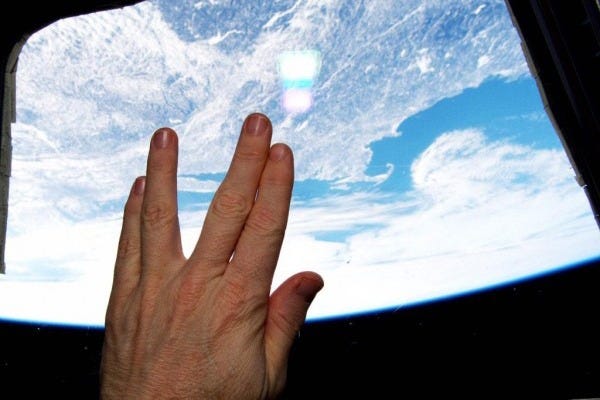
Nimoy’s own last tweet was the starting off point for millions of fans to memorialize him. Several days before he passed, he wrote this on the social media platform: “A life is like a garden. Perfect moments can be had, but not preserved, except in memory. LLAP” (of course, for “live long and prosper,” Spock’s iconic mantra). From there, fans posted tributes that combined sentiments from the man and his character, blurred in culture because of the kind of character Spock is. Even NASA posted a tribute to the man and the character that inspired so many young scientists and space enthusiasts to enter into the profession. Star Trek fans flooded social media en masse with the Vulcan salute, and the gesture became the mourning ritual itself.
The 2016 movie Star Trek Beyond, released a year after his death, was formally dedicated to Nimoy, a nod to the legions of fans who have loved him for decades. The film incorporates the death of Ambassador Spock–that is, Spock who transports from the future in the 2009 film, Star Trek–into the storyline. Young Spock, played by Zachary Quinto, plays tribute in a way that almost breaks the fourth wall. When he learns of his elder counterpart’s death, the young Spock looks through the Ambassador’s belongings, and finds a photo from the original Star Trek series of the crew.
Grief is fandom
When Dolly Parton passed away recently, the sheer outpouring of celebration through music was incredible. I heard songs of hers I had never heard before, caught clips of interviews I had never seen from decades ago of Dolly saying something profound. Her death was sad, but because fans wanted to grieve the loss together, they showed up by posting their favorite moments all over their social media while the news media showed viewers iconic moments from her long career. I learned more about Dolly Parton in a week than I had before, and I became an even bigger fan through the community celebration of her life and work.
I had a realization: fandom is always about celebration–but that doesn’t change in death or mourning. If anything, grief is when fandom expands. Whether it’s your favorite TV show getting canceled, the writing off of a beloved character, or the death of an artist beloved by fans, the grief period is fandom’s time to shine. It is in these community moments that we go above and beyond to celebrate what we love with others who love it too.
Want more? Our Discord is where you’ll find everything you need to know about the Remarkist ecosystem including Folkic, our community app and Masslore, our fandom knowledge database! And be sure to hit that subscribe button so you never miss a thing at Rmrk*st Mag!
