



The moment it came up on my Instagram feed, I laughed out loud and immediately pushed the share button. I could not believe what I was looking at. I was with my cousin at a concert, chatting before the show started and checking up on Game 4 of the NBA Finals. We are New Yorkers, so of course we were concerned about whether the New York Knicks would win this game.
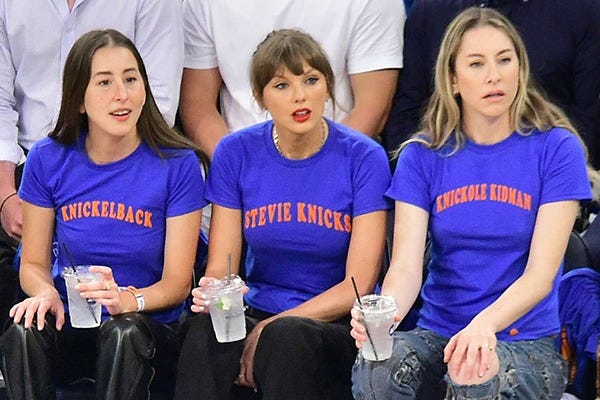
Even if you’re not from either of the teams’ hometowns, it was hard to escape the news that Taylor Swift showed up at the game with her best friends Alana and Este Haim of the band Haim. Basketball fans might have questioned their right to be on what is known as “celebrity row” courtside at the game, sitting next to longtime Knicks fans like Ben Stiller, Mariska Hargitay, Timothée Chalamet, and the king of them all, Spike Lee. But Taylor, Alana and Este didn’t show up in branded team merch to cosplay as fans for the night. They came in homemade shirts that only a craft girlie would know were fresh off the at-home press: blue tees with orange lettering with the following names: STEVIE KNICKS, KNICKELBACK, KNICKOLE KIDMAN. They brought a STEVIE KNICKS tee for Mariska, too. The joke was immediately understood, and coverage of them took over social media and traditional media alike.
After the NBA Finals Knicks win a few nights later, the streets of New York were flooded with people (I was one of them). In the days prior, I saw Knicks tees being sold on the sidewalk: homemade graffiti tees, tie dye, screen prints of players’ faces front and back. “FINALS 2026!” plastered all over. These are fun tee shirts, better than anything I’ve seen in a store or the official NBA website. And as I walked around Manhattan after the win, I saw people selling them on the street to commemorate the moment, and even more fans wearing unofficial merch they clearly either bought off the street or made themselves.
Bootleg merch has long been a part of fandom. While it’s fair that rights holders want to protect their images and don’t want to see individual creators copy their branding and sell it for less, when it comes to wearing one’s fandom, the experience is a bit more complicated. Fans usually know their fandoms better than the creatives who produce the content, and so their interpretations are what catch on and influence what they buy to wear and display. When brands get more creative with merch, and play into inside jokes of the fandom or produce niche items, fans are more likely to embrace them. We look at bootleg culture as something akin to stealing, but what if bootleggers and fandom-inspired merch creators are tapping into something more authentic about fandom itself?
How fandom finds us
Fandom is a journey. It is personal to each individual and usually starts with something small: a song you heard on the radio that made you pay attention, your dad renting the movie he loved as a kid to introduce you to it, a library book discovered at school that made you feel seen. We enter fandoms for personal reasons, because some piece of content spoke to us on some level.
We feel inclined to own a piece of that fandom. A t-shirt, a keychain, a mug. As a kid, my family went to Disney World every couple of years. Every time we went, I bought a keychain with my saved-up pennies. I had all kinds of keychains from Walt Disney World: character-themed ones, plastic logos from each of the Disney Parks, special keychains that were from the gift shops of different rides I loved. I even had one that was a little coin purse shaped like a backpack with Mickey ears all over it. I loved the keychains because they were individual to me; they represented each trip--and now their inherent kitsch is vintage.
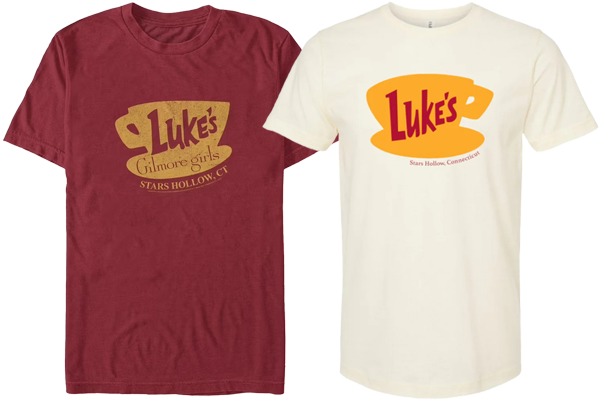
Merchandise has to speak to a fan for them to purchase it. It’s not really enough to buy something featuring a logo from our favorite show. I have a t-shirt bought from the Warner Brothers official store brandishing the Luke’s Diner logo from Gilmore Girls. On the side of the logo, it says “Gilmore Girls” on it. I remember thinking, “well that kinda ruins it.” I want a shirt that looks like it came off the set, as if Luke’s Diner itself sold it to me. I don’t want something plastered with the franchise name on it. Why is that?
As fans, we tend to want to walk around in our favorite fictional worlds as a local, like an insider. Official merch is overly brand-safe: logos and slogans are approved by a team unrelated to the content. Fans have no way of knowing if the team who conceived of the merch are fans too, but fans know when something reads as inauthentic. Fan-made merch often passes the authenticity test with other fans: the more niche, the better.
And while maybe it isn’t easy to spot a true fan next to someone who simply donned a corporate-approved shirt, it’s definitely easy to identify a fan through niche merch. So it’s ironic that merch made by fans could be classified as inauthentic, counterfeit, bootleg. I would argue that the person wearing something original is the person who really “gets” the fandom more than anything else. But homemade merch can also create a sense of inclusion for a new fan, someone who is not trying to act like they’ve been there the whole time but wants to get in on the fun too.
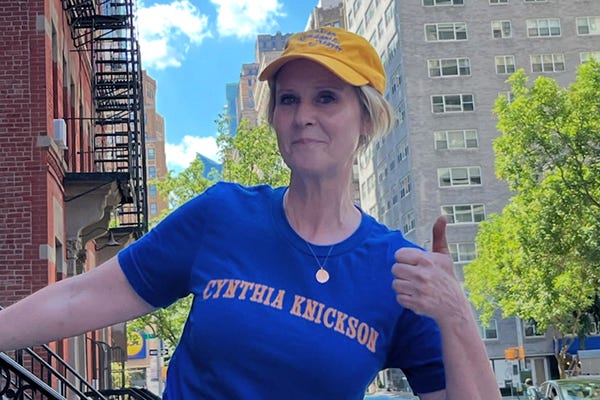
Taylor Swift and the Haim sisters aren’t known as lifelong Knicks fans like the other celebrities they were seated with. Instead of putting on Knicks merch that a stylist handed them, they opted for a more authentic approach. They didn’t pretend to be diehard fans in jerseys with player names on the back, but showed up in garb that included them amongst fans in a different way. As a fellow (proud) Knicks bandwagoner for the most exciting sports moment in my city’s recent history, I felt directly spoken to, and included in the celebration even though many sports fandoms would say I haven’t earned it. The shirt they made gave many a perfect way in. And both Knicks fans and bandwagoners like me showed up to watch parties for Game 5 in copycat merch, even coming up with new ways to emulate the idea. Actress Cynthia Nixon posted a picture on her own Instagram, sporting a Cynthia Knickson shirt.
“Inspired by” vs “infringing on”
Printing a logo on a tee or mug without legal clearance or a licensing agreement is a real bootleg. And typically, isn’t legally allowed. Fan creators on Etsy and Redbubble often get in trouble for doing this, and it makes sense from a franchise’s perspective. But fans tend to crave more creative interpretations of their fandoms anyway.
Fandoms thrive on collective inclusion. One way they do this is through inside jokes, memes, and knowledge of the latest happenings inside the fandom. I have frequented brands like Cornelia Street Shirts and Girl Tribe for Taylor Swift-inspired merch, and last fall we interviewed Dragonfly Merch Co. about their fandom-inspired merch business for Gilmore Girls. A quick search online will yield many results for fandom-inspired merch companies. The site for The Subtle Nerd shop presents a real reason for why fans love these kinds of companies. In their About section, they write, “Tired of walking through endless shops, looking for just the right item? Enter The Subtle Nerd, where you’ll find a curated section of shirts, hoodies, hats, and accessories for the nerd at heart, geek on the street, and gamer in his or her element.”
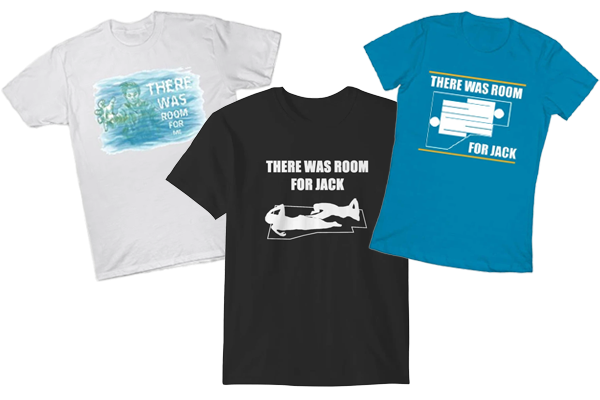
The Subtle Nerd is getting at something fans are always looking to express: a nuance, an insider perspective, something that makes them highly visible to other fans but maybe not others outside the fandom. A logo is an advertisement, but an inside joke is a social cue. Wearing a branded shirt with movie poster artwork certainly can identify you as a fan or just aware of a film’s existence, but a quote from that film or niche fandom inside joke on that tee signals real belonging to a group. You could sport a Titanic movie poster tee, or a “There was room for Jack on that door” tee, and the latter might give you a bit more street credibility as a fan.
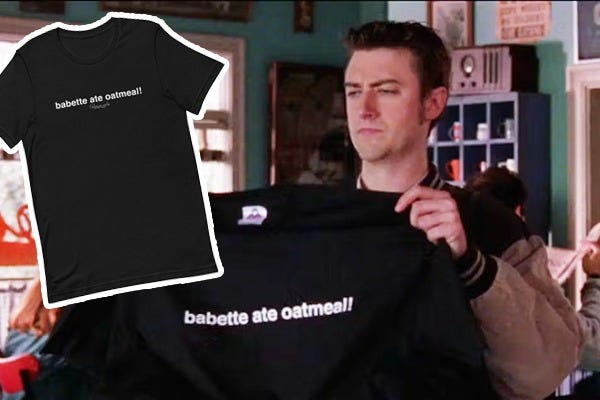
Another factor when it comes to authentic merch is speed. Sometimes things happen within a fandom and independent creators have the agility to whip up a merchandising opportunity in response faster than an official brand can. When a brand catches up, often it feels forced, and that they’re late because the moment has passed. For years, ever since the exact episode aired, I wanted a black tee that said “babette ate oatmeal” from a classic Gilmore Girls episode. In the storyline, Kirk is starting a new business to capitalize on the speed at which people want fandom merch: he creates shirts right after something has happened for members of the town to buy. The only unfortunate thing for him is that, nothing that exciting happens in Stars Hollow; it’s all very mundane. But therein lies the joke. I saw creators making the shirt all over the internet in various fonts and styles. But I wanted the exact shirt that the character Kirk tries to sell: no logos, just Kirk’s creation. Recently, I saw an official version on the Warner Brothers website, which feels extremely late and inauthentic to the moment.
The fan-made merch economy
Simply put, personal economics are a barrier to merch-buying. The concert ticket is expensive enough, and a concert tee might start at $50 for something generic, a logo or name on an itchy tee. Especially when fans are newer, or younger, disposable income that they can spend on souvenirs is tough to come by. Even when fans are eager to spend on merch, consider access: the Eras Tour made the news for incredibly long lines and selling out of some of the hottest merch items, even several days before a concert in any given city on the tour. Facebook groups had fans helping each other out, buying on site and mailing to out of state fans, and resell sites were lit up with popular merch items that were impossible to find otherwise.
Bootlegs, fan-made merch, and companies that make fandom inspired merch democratize access by offering something for everyone. When fans can’t get the merch they want from an official source, they turn to other platforms: Etsy, Amazon, Redbubble, or their own craft store. And, while they love a hot item that is going viral amongst fans, they also create their own phenomena.
One of the biggest fan-made merch stories in recent years is the making of friendship bracelets during the Eras Tour. Making this kind of merch was a totally fan-led operation that Taylor Swift herself never capitalized on; she even joked on “The Graham Norton Show” that she should have invested in beads, had she known what would happen.
Fans seized on a line from her song “You’re On Your Own, Kid” that says, “Make the friendship bracelets/take the moment and taste it” which dovetails beautifully with the experience of going to a once-in-a-lifetime concert with friends and family. So fans made bracelets, all kinds of them. And because they were handmade, they were personal. And what did we all learn as kids that you do with a friendship bracelet? You trade them, which fans did at shows and all around stadiums. The tradition even spread to many other fandoms, and fans have been trading bracelets at other shows and conventions outside of the Swift fandom.
Making friendship bracelets isn’t a new tradition; Taylor Swift mentioned it in a song because it’s something people have done for decades. But making the bracelet itself into Taylor Swift-inspired fan-created merch that is recognizable across every demographic of the fandom and beyond was a revelation. Most importantly? They were cheap. Sure, you could buy friendship bracelets someone else made online, or you can purchase a fancy bead kit to make them. But most fans could purchase a kit for a few bucks, turn making bracelets into an activity shared with friends, and the bracelets themselves became their own memory of the tour and the consumption of it–even if you only watched the movie release in theaters or consumed videos from the concerts at home.
The psychology of the souvenir
I knew as a kid why I wanted those Disney World keychains. It was a souvenir, one I could afford on limited allowance. Apparel and larger items were so expensive, and my parents were very strict about buying stuff for my brother and me while we vacationed. They always prioritized the experience of going over the cost of buying “junk” I probably wouldn’t care about much longer after we returned home. The keychains were more personal, because I bought them myself. They were economically available because they didn’t cost that much, and they were small and didn’t take up a ton of room in my luggage. But they meant a lot to me: they were my souvenirs of the experience, not meaningless pieces of plastic. I used to spend the week at Disney World hunting for the perfect encapsulation of my trip. You can walk into any gift shop and see hundreds of keychains all over the resorts and parks. So picking just one was a vacation-long challenge. And I did it every time.
There is a key difference between the souvenir of the experience vs. a souvenir of the brand. A bootleg tee sold on the street outside of a concert belongs to the fan community, not the corporation–so it represents the fan and the experience (like, say, the thrill of buying a tee on your way out of the venue from a guy selling them out of a box). My best friend and I bought tees from a guy in the parking lot after a New Kids on the Block concert with opener Jesse McCartney while giggling about buying “crappy” shirts with the last bit of cash we had. I still have it, and I’ve never worn it; the hilarious memory of the purchase is stronger than even my memory of the concert. I was with my friend, we were laughing, we’d just had a fantastic time scream-singing “Hangin’ Tough” with the boys and thousands of other fans. And the bootleg tee is proof of it.
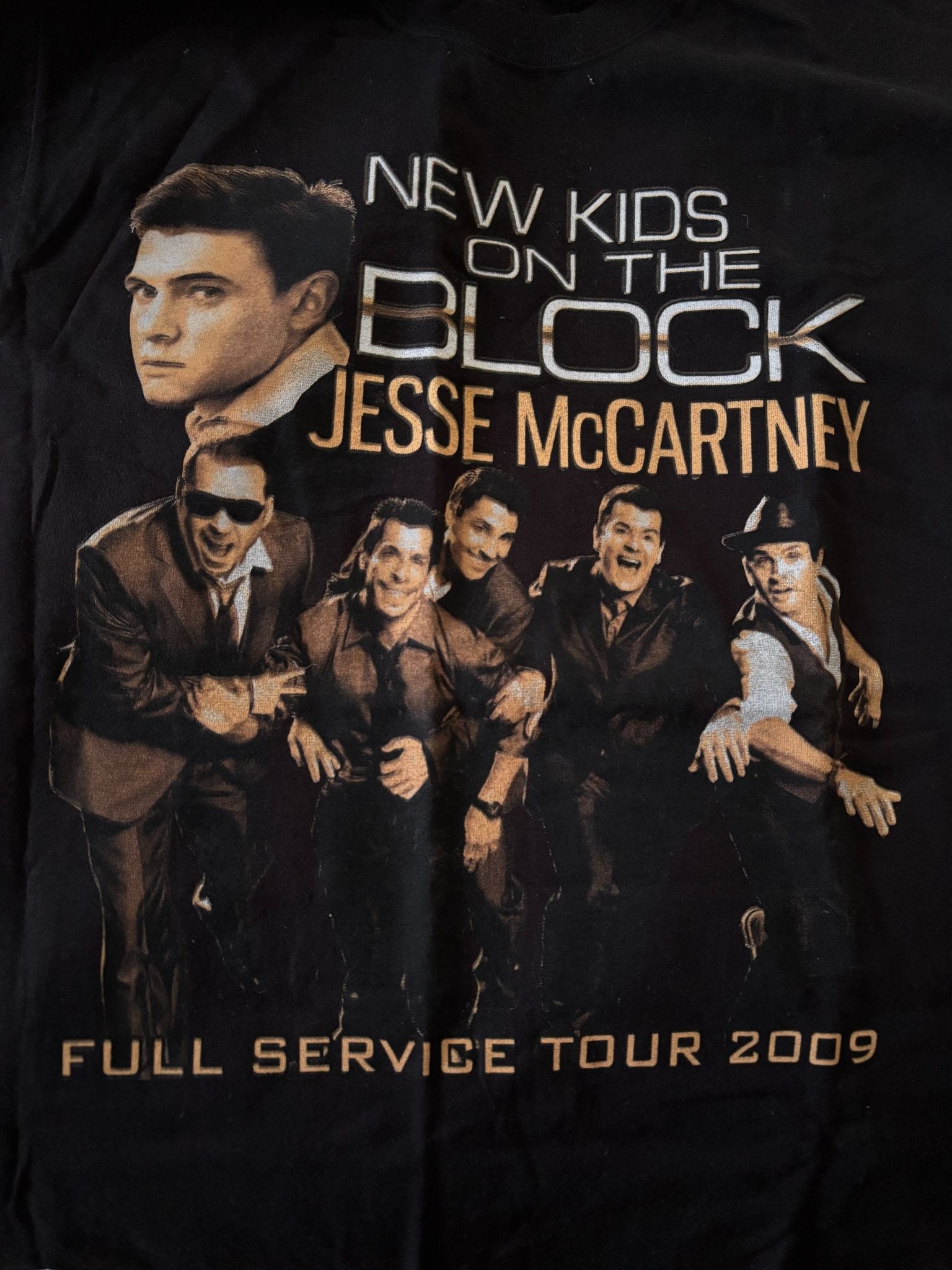
A souvenir that represents an experience rather than a brand is inherently more significant to a fan. You could buy merch at a concert, or a few weeks later online. But there’s something special about procuring a merch item during the event itself–or making something niche to wear to it. In 2011 psychology researchers coined the term the IKEA Effect, meaning that we place more value on items that we partially make ourselves. So making a tee shirt, costume, or bracelet for a fandom event might be more valuable to us as a souvenir from the experience than anything we might buy.
You’ve likely heard the phrase “you are what you own.” The phrase comes from consumer psychologist Dr. Russell Belk, whose 1988 theory of the Extended Self states that our identity is extended to the things we collect. Souvenirs fall into this category; even if we don’t use them, we tend to hold onto objects whose value is symbolic to us. Souvenirs help tell a story about who we are, both to ourselves and others.
Supporting other fans
Fandom is a collective activity, and inside of it, we build community. This support extends to how and why we purchase merch. When I’ve been shopping for fandom items to wear to events, I have always found the most interesting products from individuals and companies that are fans themselves. They always carry the most unique and niche goods, because they care about the content like I do. I treasure my “I Am An Autumn” sweatshirt from Dragonfly Merch Co., which I wore to the Smells Like Snow and Coffee Festival in Akron, OH last fall. I ordered it ahead of time, but I made sure to stop by their booth at the festival. I definitely didn’t need another Gilmore-inspired tee, but it just feels so great to support other fans by buying their items and so, I walked away with one more.
What do bootlegs reveal about fan culture?
Bootleg merch speaks to a fandom prioritizing their interests over straight branding. Fans value accuracy, speed and community-understood signifiers. They would much rather show others that they get the inside joke or niche understanding of the fandom over sporting its official logos. This understanding shows others that they are legitimate; their fandom is real and they have earned the right to be included in the group.
Bootlegs also expose holes in the market for engaged fans. The Click Clack Show, which describes itself as “a women’s sports podcast about more than the game” pointed out in an Instagram post that Taylor Swift and Haim’s homemade Knicks shirts weren’t just clever and fun, but actually revealed a lot about how men’s sports organizations like the NFL, MLB, and NBA don’t make merch that caters to what women actually want to wear. They are forced to wear shapeless unisex tees and jerseys, or the dreaded pink merch that all teams seem to make (what’s the point of wearing team merch if it’s not in the team color?). The caption reads, “Women don’t just want shrunk-down men’s jerseys; we want style, culture, and humor mixed into our fandom.” Women want to be included, and if they can’t buy official merch, they will make their own.
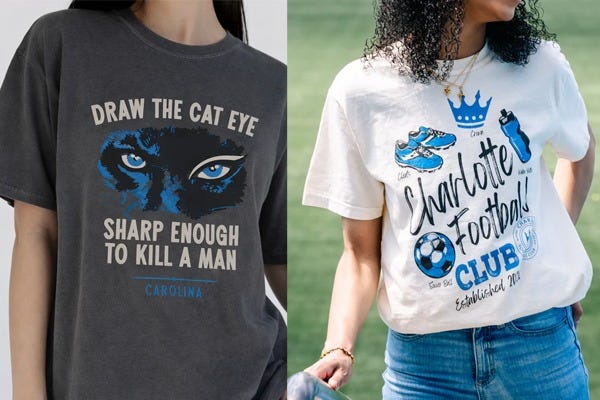
But even if brands catch up and provide niche-specific items that fans really want, fans will always create their own fandom-inspired merch. And as long as they don’t infringe on copyright, these items will always feel more personal and exist as one-of-a-kind pieces that feel like wearable fan art. Merch will always be a part of fan expression, and how original it is will always be up to the fan.
Want more? Our Discord is where you’ll find everything you need to know about the Remarkist ecosystem including Folkic, our community app and Masslore, our fandom knowledge database! And be sure to hit that subscribe button so you never miss a thing at Rmrk*st Mag!

100% agree! 😁👌